
Basketball plays and strategy
2-3 zone defense basketball: positions and rotations
A 2-3 zone starts two defenders high and three nearer the basket. As the ball moves, each defender needs a clear handoff: who meets the wing pass, who covers the corner and who stays with a cutter.
Check that a zone is permitted before teaching it for competition. In this original example, the nearer high defender meets a wing pass, the ball-side low defender meets a corner pass and the other low players protect the basket area. The group then finds opponents when a shot goes up. Walk this rotation before adding live play; use the handoffs your program teaches.
The NBA/USA Basketball charts for ages 7–8 and ages 9–11 recommend player-to-player set defense. This zone example belongs only in a program that permits it.
On this page
When a zone is permitted
For another league or age band, get the adopted defense rule before using this system in competition. Keep the player-to-player version available when the program’s restrictions require it.
Even where a zone is legal, a group still needs to contain the ball, see a cutter and rebound without pushing. Use those skills as the readiness check. A zone should not become a way to leave a beginner permanently under the rim without teaching movement.
Starting positions
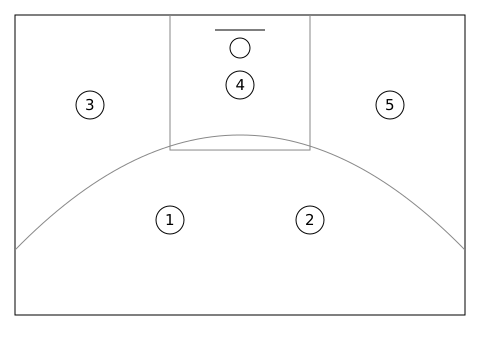
Tell each player which area begins their job and which teammate takes the next pass. Defenders do not stand on invisible spots while the ball moves freely. They adjust to the ball and nearby receivers, while keeping a view of the basket area.
Ball-side and corner rotations
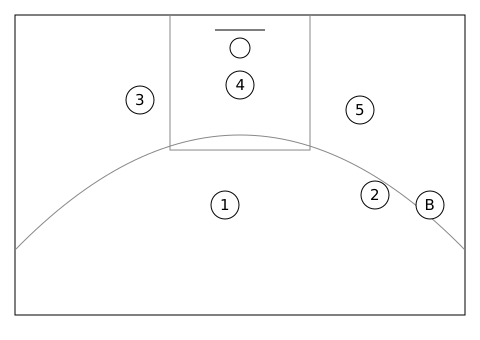
For a pass to the right wing, 2 moves toward the ball under control. Player 1 narrows toward the middle, 5 watches the low right area and 4 remains near the basket. Player 3 sees the weak-side receiver and the rim. Walk this before adding a dribbler.
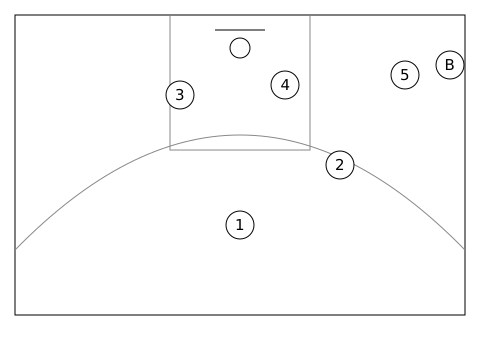
For the next pass to the right corner, this example sends 5 to the ball. Player 2 drops toward the return window rather than chase 5 into an unplanned trap. Player 4 shifts toward the ball-side basket area and 3 narrows from the weak side. Player 1 sees the middle and next reversal.
If the corner player passes back out, the high defender returns to the ball while the low defender restores the lower space. Don't make the ball handler wait merely because the walk-through is unfinished. First stop and reset the lesson; later let the pass reveal a late rotation.
Rebounding responsibilities
A zone spot does not block out a person by itself. On the shot, each defender finds a nearby opponent and a legal path to the ball. Keep the first lesson free of contact while the group learns to see both. Do not teach an arm push or a backward shove as a rebounding method.
Use a gentle adult toss for the first rebound rather than a hard shot over a crowded group. Ask who can reach the ball and who remains ready for an outlet. End after secure possession. The task is to finish the defensive action, not keep standing in the formation.
Gaps and trade-offs
The pass between two starting areas can be hard to assign if teammates do not communicate. A high-post receiver may sit between the high pair and low line. A corner pass can pull a low defender away from the basket. These are examples to rehearse, not proof of a fixed success rate against the zone.
Decide who calls the handoff for each practice sequence. Keep the call short and tied to the ball location. If two defenders run at the same player, pause to restore the other receiving windows. A double-team should be a deliberate permitted choice, not an accident caused by unclear jobs.
Teach one rotation at a time
Use a ball held on the wing to check the handoff before any live pass. Ask the nearest defender to show the approach path. Ask the next defender to point to the space that path leaves. If both follow the ball, walk their separate jobs again. Keep the ball still while the group explains the change.
Then move the ball back toward the top and watch the return to useful spacing. A corner closeout alone does not show that the group can recover after a pass out. Add a controlled shot only after that return is clear. End the example by finding an opponent and securing the ball, rather than by posing in the starting formation. These are teaching checks for this example, not required rotations for every team.
An original sequence starts with a stationary ball, then a top-to-wing pass, then a wing-to-corner pass. Walk each step and let every player change position. Add a slow ball reversal only after the group can name the first handoff. Use no contact until the routes are clear.
FAQ
Is the zone suitable for every young beginner?
No. Check the competition's rule and the group's basic defensive skills. The named younger-age guidelines use player-to-player set defense. Even a legal zone requires players to see, move and finish possession. Do not use its fixed starting picture as a reason to stop teaching those individual decisions.
Does the corner always require a trap?
No. This example uses one defender at the corner and keeps the other connected to a return pass. A trap would be a different teaching choice with different gaps and rule limits. Teach the intended handoff first rather than allow two players to crowd the ball without a plan.
Choose the next coaching task
Youth Basketball Tips · https://youth-basketball-tips.com/2-3-zone-defense-basketball/