
Rules, signals and court dimensions
Basketball court dimensions: diagrams and ruleset comparison
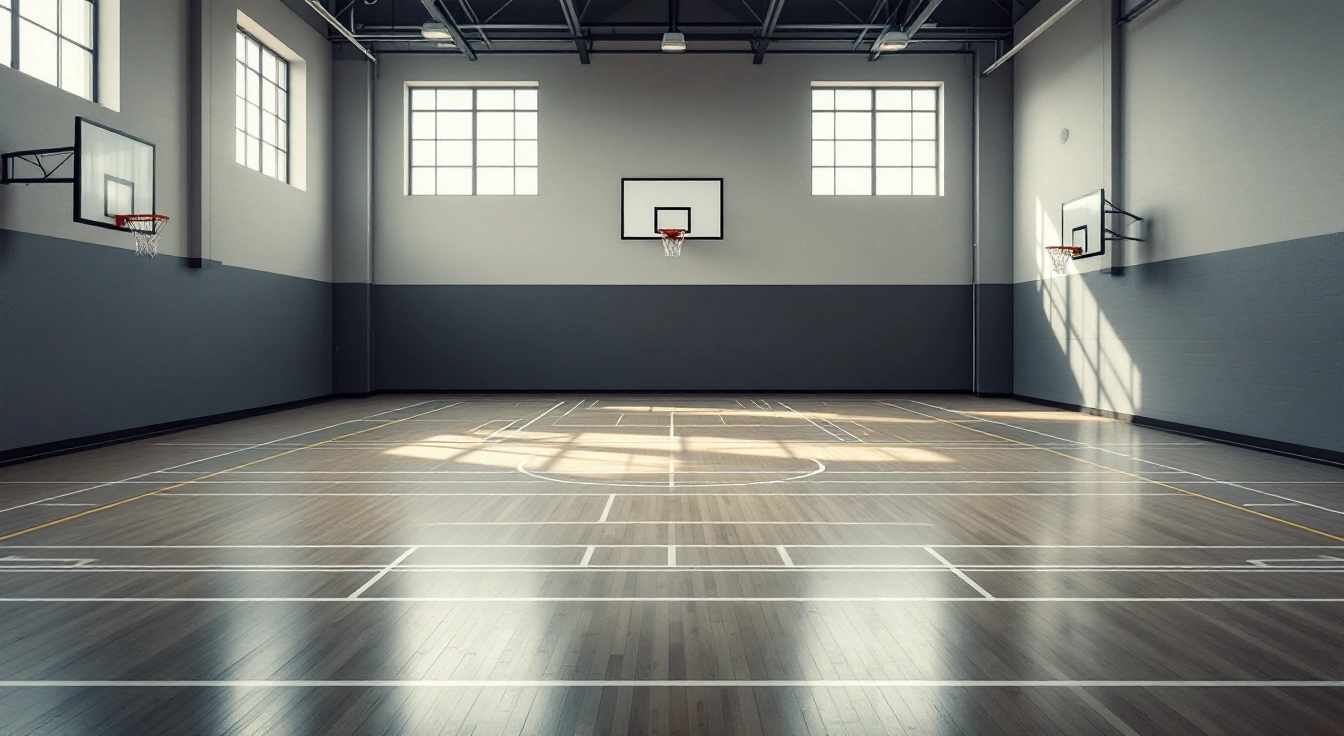
Basketball court dimensions depend on the rules used for the game. A school court can be shorter than an NBA court. A shared gym may have several sets of lines. Find the right boundary before you measure a lane or an arc.
The NFHS school diagram gives an optimum playing area of 84 by 50 feet. NBA and NCAA full courts are 94 by 50 feet. FIBA uses 28 by 15 meters. Youth guidance includes smaller courts. These are playing boundaries, not the full floor or land needed. Check the named source and your league before marking a court.
On this page
Choose the ruleset before measuring
Ask the organizer which code and age group use the floor. Then ask which color of line counts. An NBA arc outside a school arc does not turn a school floor into an NBA court. Read the basket and free-throw line with the same set of boundaries.
For practice, you can mark a smaller area without calling it regulation. Show players where to stop and where to wait. Flat markers can define a teaching space. They do not certify a floor for a league game.
Full-court dimension table
Feet and meters below are native source units. The youth charts are guidance, not rules for every local league. The NFHS diagram calls its 84-foot length optimum and notes that some diagram details are suggestive.
| Rules or guidance | Playing length | Playing width | Source and edition |
|---|---|---|---|
| NFHS school reference | 84 ft optimum | 50 ft | NFHS public court diagram; no season printed |
| NBA | 94 ft | 50 ft | NBA live overview and Rule 1 court reference |
| NCAA men and women | 94 ft | 50 ft | 2026-27 court diagram in 2025-26/2026-27 women’s book; updated September 1, 2026 |
| FIBA five-on-five | 28 m | 15 m | Official Basketball Rules 2026, v1.1, Article 2; valid October 1, 2026 |
| NBA/USA Basketball ages 7-8 | 50 ft | 42 ft | Published youth Rules and Standards chart, 2018 file |
| NBA/USA Basketball ages 9-11 | 74 ft | 50 ft | Published youth Rules and Standards chart, 2018 file |
| NBA/USA Basketball ages 12-14 | 84 or 94 ft | 50 ft | Published youth Rules and Standards chart, 2018 file |
| Your local program | UNKNOWN | UNKNOWN | Ask for its adopted layout |
Scroll for more →
Measure the playing area from the edge the source names. NCAA Rule 1 uses the inside edges of the boundary lines. FIBA Article 2 also uses the inner edges. Space outside those lines is a separate check, even when the floor is painted the same color.
Original court and marking diagrams
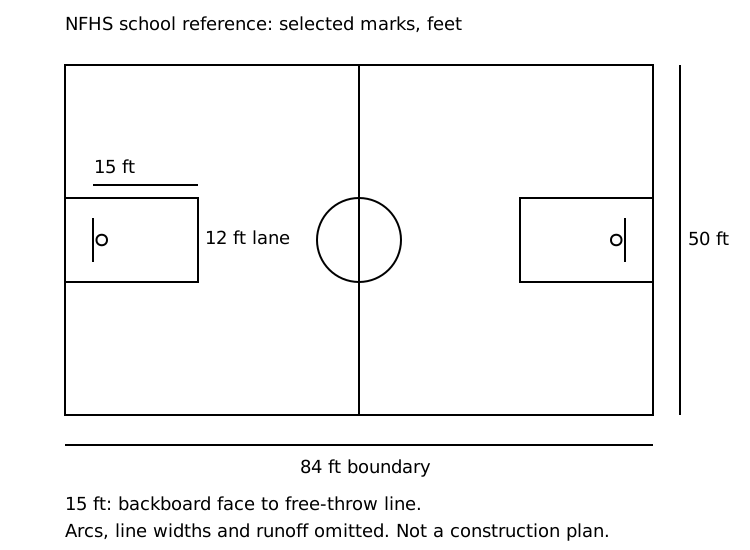
The long sides are sidelines. The short sides are endlines, often called baselines. The center line divides the court into two halves. A backboard stands in from the endline, so a distance measured from its face has a different start from one measured from the endline.
This drawing shows a school boundary with selected marks. It omits arcs to keep the reference clear. Use the full official diagram when checking an arc or line width. Do not add a pro arc to this plan and call the result a school standard.
Hoop, backboard and key measurements
The key usually means the lane near the basket. Its width varies by code.
The school diagram shows a 12-foot lane. NBA Rule 1 and its court diagram use a wider lane. A painted edge can belong to another sport, so check the line before taking a width.
| Named source | Selected mark | Distance and reference point |
|---|---|---|
| NFHS public court diagram | Lane width | 12 ft |
| NFHS public court diagram | Free-throw line | 15 ft from backboard face |
| NBA live Rule 1 | Ring height | Upper edge 10 ft above the floor |
| NBA live Rule 1 | Free-throw line | 15 ft from backboard face |
| NBA live Rule 1 | Three-point arc | 23 ft 9 in from basket center; parallel lines 3 ft from sidelines |
| FIBA 2026 Article 2 | Free-throw line | Far edge 5.80 m from inner edge of endline |
| FIBA 2026 Article 2 | Three-point arc | 6.75 m radius to outer edge from point below basket center |
Scroll for more →
The FIBA free-throw figure above starts at the endline. The NBA figure starts at the backboard face. They cannot be compared as if their starting points were the same. Keep the source's wording about inner, outer or far edges beside the number.
Youth modifications and available space
Check the ball and basket setting with the court size. A shorter court with adult lines does not become a defined youth court by itself. The youth charts also set age-based free-throw distances. Use the chart as a whole, then confirm the rules your program adopts.
For a no-hoop passing task, state the clear space you need. There is no need to call it a regulation area. For shooting, keep a clear route to collect the ball. Place other stations outside the shot and return routes.
If the floor cannot fit a task, change the task. A boundary number cannot tell you whether the floor is sound or the hoop is fixed well. It also cannot approve the space for spectators or a portable base.
Reading units and ruleset editions
One foot equals 0.3048 meters. Thus 84 feet equals 25.6032 meters, or 25.60 when rounded to two decimal places. That is a unit conversion of the school length. It is not the native FIBA length of 28 meters.
Use a source's own units first. Add a conversion only when it helps the job, and label the rounding. A rounded metric figure on a sales page may describe an imperial court. Ask which standard the supplier means rather than assume the two are the same.
The FIBA source is the 2026 edition, valid from October 1. The NCAA source covers the 2026-27 season and includes a diagram labeled for men and women. NBA Rule 1 is a live web reference. NFHS's public diagram has no season on its face; get the school's current adopted rules before certifying a court.
Related rules and half-court guidance
For a practice sheet, write the chosen boundary and basket setting with the local rules. That gives an assistant a clear setup to use. If a number is unknown, leave it unknown until the organizer confirms it. Do not estimate a regulation claim from a picture.
FAQ
Is a 94-foot court required for every school?
The NFHS public diagram gives an optimum 84-foot school length. NCAA and NBA courts use 94 feet. Those numbers belong to different references. Ask which code and local requirements apply before using a pro figure for a school facility.
Can a diagram tell me the land area for a backyard court?
A playing boundary is only one part of that job. Clearances and the hoop support need their own checks. The surface and site also matter. Take the actual model’s instructions and local requirements to the people planning the installation; do not treat this teaching drawing as a site plan.
Choose the next coaching task
Basketball rules for beginners
Youth Basketball Tips · https://youth-basketball-tips.com/basketball-court.html