
Rules, signals and court dimensions
Basketball referee signals: an illustrated coach’s reference
Basketball referee signals combine a visible gesture with the situation and the official's spoken report. Use this guide to help adult coaches recognize a call and explain a calm next action. Do not infer a complete ruling from a single still pose.
The chart below groups common NFHS signals for the clock, scoring, violations, fouls and administration. Each has an original abstract figure and a text description of its motion. The reference is the public NFHS signal-chart file labeled 2024-25. These entries are not labeled NBA or FIBA signals and are not an officiating qualification.
The NFHS signal chart pairs gestures with rulings. Read a signal with the whistle and ensuing restart; a copied pose alone cannot identify every call.
On this page
How to read this signal guide
Start with the whistle and the direction of the official's attention. A raised arm can stop the clock, indicate an attempt or begin a reporting sequence. The hand and the motion matter. Read the whole entry before using a gesture to explain a call.
The figures deliberately use a plain stick form, with no governing-body logo or copied manual art. They show the position in a simple way; they cannot reproduce timing. A caption supplies the hand action when the small figure cannot show fingers clearly. All text remains available when images or JavaScript are disabled.
Our IDs such as C1 and F2 are page reference labels, not official NFHS signal numbers. Use them when reporting a correction to this page. Don't put them on a score sheet as if they were the governing body's code.
Scoring and clock signals
Separate a clock instruction from a scoring decision. A stop-clock gesture tells the timer to pause; the next gesture and report explain why. Likewise, the signal for a three-point attempt does not mean the basket was made. Watch the completed sequence before explaining it to the group.
C1: Stop clock
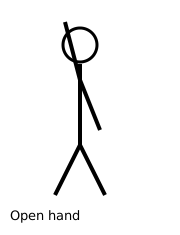
Group: Clock. Gesture: Open hand above the head. Meaning: Pause and wait for the official to administer the next action.
NFHS public signal chart, 2024-25 file. Original abstract Youth Basketball Tips figure; read the text for the motion.
C2: Stop for foul
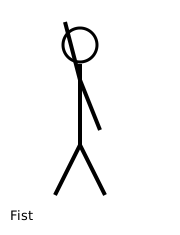
Group: Clock. Gesture: Clenched fist above the head. Meaning: The clock instruction alone does not identify the kind of foul. Watch the reporting sequence.
NFHS public signal chart, 2024-25 file. Original abstract Youth Basketball Tips figure; read the text for the motion.
C3: Start clock
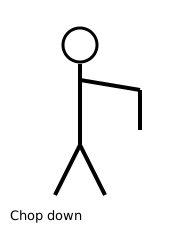
Group: Clock. Gesture: A downward chopping motion with an arm. Meaning: A timer instruction accompanies live action. A spectator should not operate the clock from a guessed gesture.
NFHS public signal chart, 2024-25 file. Original abstract Youth Basketball Tips figure; read the text for the motion.
S1: Three-point attempt
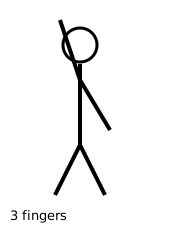
Group: Scoring. Gesture: One arm raised with three fingers extended. Meaning: The attempt signal is separate from a made basket. Do not count the attempt as a score.
NFHS public signal chart, 2024-25 file. Original abstract Youth Basketball Tips figure; read the text for the motion.
S2: Three-point made
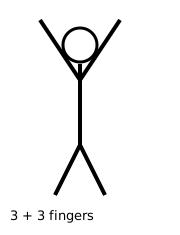
Group: Scoring. Gesture: Both arms raised with three fingers extended. Meaning: Read the completed scoring signal before comparing it with the scoreboard.
NFHS public signal chart, 2024-25 file. Original abstract Youth Basketball Tips figure; read the text for the motion.
When teaching, demonstrate away from active play. Ask an adult to show the motion slowly while another says its meaning. Players should continue to follow the actual official during a game. A coach's imitation is a learning example, not a replacement instruction to the timer.
Violation signals
A violation signal helps name the interruption, but a coach still needs the exact action that caused it. Travelling can involve the wrong planted foot or an illegal return to the floor. The gesture alone does not identify that detail. Ask for the situation, then rehearse a simpler legal action.
V1: Travelling
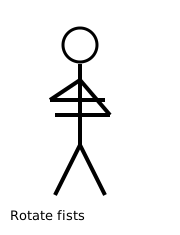
Group: Violation. Gesture: Closed hands rotate around each other in front of the body. Meaning: Use the call to rehearse the particular stop or pivot, rather than a blanket two-step slogan.
NFHS public signal chart, 2024-25 file. Original abstract Youth Basketball Tips figure; read the text for the motion.
V2: Illegal dribble
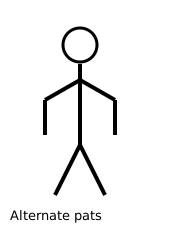
Group: Violation. Gesture: Alternating patting movement with the hands. Meaning: Explain when the dribble ended and what legal next choice was available.
NFHS public signal chart, 2024-25 file. Original abstract Youth Basketball Tips figure; read the text for the motion.
For a dribble lesson, pause a still demonstration at the moment both hands meet the ball. Ask the group what choices remain under its adopted rules. Do not teach every ball-handling error as the same violation. The local code and the official's judgment determine the game call.
Foul and administration signals
Keep the call separate from its penalty. A signal that identifies holding does not, by itself, tell you whether a particular free throw, throw-in or other action follows. Team-foul state, act of shooting and the adopted rules can matter. Let the official finish the report.
F1: Holding
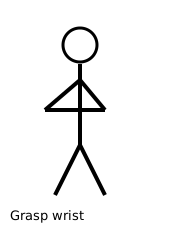
Group: Foul. Gesture: One hand grasps the opposite wrist. Meaning: Do not teach the gesture by grabbing a partner. Use the abstract drawing or an adult demonstration in clear space.
NFHS public signal chart, 2024-25 file. Original abstract Youth Basketball Tips figure; read the text for the motion.
F2: Blocking
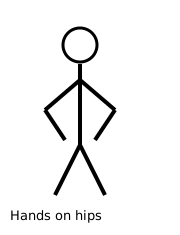
Group: Foul. Gesture: Hands placed at the hips. Meaning: This names the reported foul, not a claim that every collision by a still player is legal.
NFHS public signal chart, 2024-25 file. Original abstract Youth Basketball Tips figure; read the text for the motion.
F3: Pushing or charging
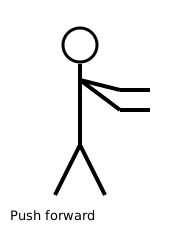
Group: Foul. Gesture: Hands extend forward in a pushing motion. Meaning: The same chart entry covers these reported actions. Context and the official report distinguish the incident.
NFHS public signal chart, 2024-25 file. Original abstract Youth Basketball Tips figure; read the text for the motion.
A1: Directional signal
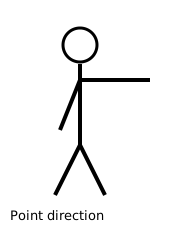
Group: Administration. Gesture: An arm points in the direction of play. Meaning: Follow the official direction rather than the direction the ball happened to roll after the whistle.
NFHS public signal chart, 2024-25 file. Original abstract Youth Basketball Tips figure; read the text for the motion.
A2: Beckon substitutes
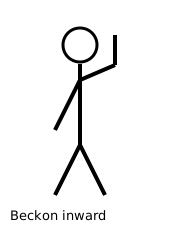
Group: Administration. Gesture: A hand beckons the substitute toward the court. Meaning: A player waiting to enter should follow the official and the competition procedure.
NFHS public signal chart, 2024-25 file. Original abstract Youth Basketball Tips figure; read the text for the motion.
An adult can model the pushing gesture without touching anyone. The purpose is to recognize the communication. Do not have children imitate a foul on a partner so that they can memorize its name. Teach an alternative legal movement after identifying the call.
Ruleset differences
These entries use one NFHS chart. A familiar-looking signal from another code is not proof that its meaning or penalty is identical. FIBA's 2026 changes include revised foul categories; this guide does not silently map the older NFHS names onto that code. Obtain the current source for the competition you are watching.
For a school competition, ask the organizer which code and season apply. For a recreation program, ask whether it uses modified rules and which signals its officials teach. If no code is confirmed, treat a disputed interpretation as unknown rather than fit it to a diagram here.
Printable signal chart
Print this page from the browser to retain each figure with its motion description. The print style removes navigation and photography while keeping source and version details. Use US Letter or A4 and preview the pages before printing; cards should remain together. No signup or child information is needed.
With JavaScript off, use the browser's own Print menu. The complete chart is already in the HTML. There is no filter that hides part of the reference, and no download containing a merchant link. This printable is a coach's reading aid, not a substitute for an official's current manual.
Use the right signal edition
The source chart is the 2024-25 edition. A later competition may use a newer chart. Ask the responsible organization about any newer chart or local interpretation.
To request a correction, include the entry ID, the specific gesture or meaning and an official source URL. Leave out player names, game video and personal information. A corrected figure should keep a dated record of what changed and why. The useful basketball referee signals lesson ends with recognition and a calm response, rather than an argument over an isolated pose.
FAQ
Does a still picture show the whole call?
Some signals include motion or a second gesture. Read the action text and the official’s full sequence, rather than guess from a frozen arm position. The chart here names its NFHS source. Another code may use a different gesture or reporting sequence.
How can an adult teach signals without copying a live dispute?
Choose one common stoppage before practice. Show its gesture slowly, explain the action and rehearse what players do next. After a whistle, players can stop and look. Keep any rules question for the proper adult discussion with the official.
Choose the next coaching task
Youth Basketball Tips · https://youth-basketball-tips.com/referee-signals.html