
Basketball plays and strategy
Basketball plays: simple diagrams for youth coaches
Basketball plays help a group share the same next decision. Start with a pattern the players can see and pass through, rather than the longest set they can memorize. This adult playbook gives three original examples: a spacing-and-cut action, a simple inbound and a defensive handoff.
Choose a play by the group's receiving skills, usable space and adopted rules. Teach the starting positions, one first action and a fallback when that action is covered. Walk it without defense before adding a reading decision. The diagrams here are authored examples with no claim of testing, official status or guaranteed scores. A player who keeps the ball when a window closes may be making the right choice.
USA Basketball’s motion-offense guidance links spacing with player movement. The frames below use that teaching idea: a cut clears room for the next receiver.
On this page
Choose a play for the players
Ask what problem you need the play to solve. A team that crowds the lane needs clearer spacing. A group that cannot restart against passive pressure needs a visible outlet. A group that watches shots without finding opponents needs a possession-ending task. Those are different lessons, even if a single diagram could show all of them.
Check the ball and basket, then the distance of the required passes. If an outside receiver cannot be reached with a controlled throw, shorten the spacing or choose a smaller game. A professional-looking layout does not prove a young group can use it. The court's adult markings need not become the starting spots for every practice task.
Confirm defensive and restart restrictions. The NBA/USA Basketball younger-age charts use player-to-player set defense, and local programs can modify other parts of the game. If the program prohibits a zone, a screen or a press, leave that tactic out of the play. A “youth” label does not override the rule.
Use positions as temporary learning jobs. Rotate the first passer and cutter, then the inbounder and defender during practice. Avoid building a whole session around one child making every decision while others stand still. A useful play should give each participant something to see and a clear next action.
Read the diagram legend
The basket sits near the top edge, which is the baseline. Numbers label starting jobs, not named children or permanent positions. B marks the ball when it is outside the numbered players. I marks an inbounder outside the boundary. D and H mark defenders in a teaching frame.
Solid arrows show a player's movement. Dashed arrows show a pass. A pass arrow offers a possible window, not an instruction to throw through a defender. If a diagram shows two possible routes, the text explains which one is used and which remains a fallback.
The pictures are schematic and not to scale. They are original artwork, not copied rulebook or commercial playbook diagrams. They give no measured screen distance, certified clearance or guaranteed pass angle. Use the text equivalent when a small picture is hard to read, and walk the setup in the actual available space.
The frames are static on purpose. A coach can pause at each one and ask what the next player sees. No animation is needed to use the sequence, and every description is present without JavaScript. Printed frames retain the same labels and source date.
A simple spacing-and-cut sequence
Frame 1: make the first pass readable
Start with five outside spots: top, two wings and two corners. Keep a clear middle. The player at the top has the ball and looks for a ready wing receiver. The other wing does not move into the top until the cutter leaves it.
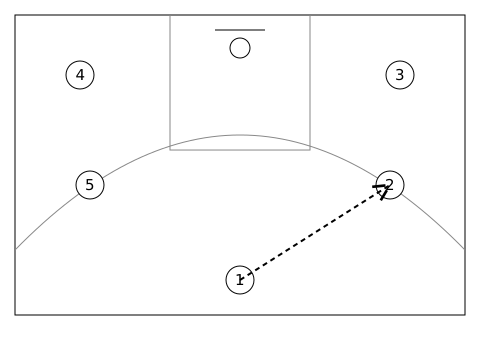
| Job | First action | Useful observation |
|---|---|---|
| 1, first passer | Pass only to a ready wing | The ball reaches a controlled catch |
| 2, receiver | Look toward the open middle | The cutter is seen before a return pass |
| 3, near corner | Keep width on the right | The lane beside 2 stays usable |
| 4, far corner | Wait for the cut exit | No early movement into the cutter |
| 5, opposite wing | See the space 1 leaves | Top fills after the cut clears |
Scroll for more →
Frame 2: cut, clear and refill
After the pass, 1 offers a cut toward the basket. Player 2 returns the ball only if the lane and catch are open. If the window closes, 1 continues out toward the far corner, 4 moves up to the left wing and 5 fills the top. Player 3 leaves room on the ball side.
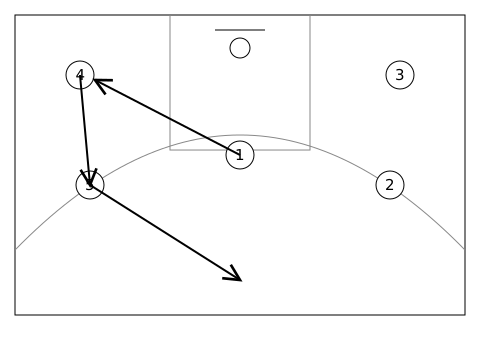
Walk the refill before adding a defender. Then use one passive defender to close the return cut. The correct answer can be the outside pass to the new top. Reward seeing that route rather than the mere completion of the expected cut.
If two players occupy the same outside spot, restore the first frame and slow the timing. Ask who leaves first and who follows. Don't add another cutting rule to fix a missed first rule. A short successful sequence is enough material for the next practice.
Scale the action down
With three attackers, keep only the top and two wide spots. The passer cuts and exits to an empty outside area while the third player fills. This keeps the same reading without five simultaneous jobs. It is a modified teaching game, not official FIBA 3x3 rules.
With one basket and a large group, let the next group walk the spacing in a separate clear no-shot area. Exchange groups after a brief turn. Do not put the waiting group's route behind the active rebounder. The adult needs to see both areas before choosing to run them at once.
An inbound example
Frame 1: a short receiver and a separate outlet
Use the actual official's designated baseline spot in a game. For this practice picture, I begins outside the right side of the baseline. Player 1 is the nearby option, 2 the outside outlet, and 3 and 4 stay clear on the other side. The inbounder waits for a visible target.
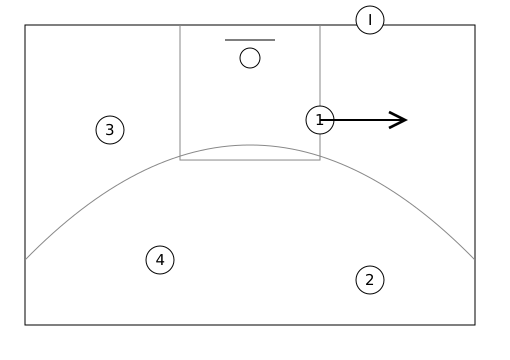
| Job | First option | Fallback discipline |
|---|---|---|
| I | See 1 in the short window | Keep balance and look to 2 if covered |
| 1 | Offer a short catch | Clear rather than block 2’s route |
| 2 | Stay visible outside | Move to an open angle if 1 is denied |
| 3 | Keep opposite-side space | Do not drift into the first catch |
| 4 | Hold a distinct outside window | Avoid following the ball into 2 |
Scroll for more →
Frame 2: recognize a covered first option
Add a passive defender at 1's receiving lane. Player 1 clears that window and 2 shows a different outside angle. I passes only if 2 is visible and ready. A defender closing the first route should create a decision, not a command for I to throw harder.
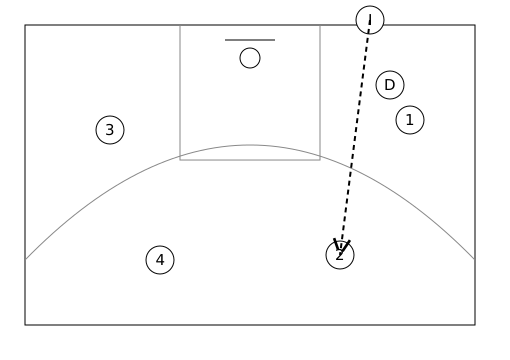
Confirm the throw-in time and movement rules before adding the competition version. Some restarts allow movement along the endline; others use a designated spot. Do not teach the after-score rule as the rule for all baseline throws. A timeout or other escape also depends on the adopted code.
Practice from the left side after the right-side decision is clear. Let every player inbound. If the outlet pass is too long, move the outside receiver into a shorter useful angle rather than keeping a diagram distance at the cost of control. The picture is a teaching aid, not a measured requirement.
A defensive teaching setup
Frame 1: see the ball and the assigned player
Use this only where the program permits the planned help. B has the ball on the right, D guards the ball, A is the off-ball receiver and H is responsible for A. H begins in a position from which both B and A can be seen. The remaining practice players can observe or rotate into those jobs.
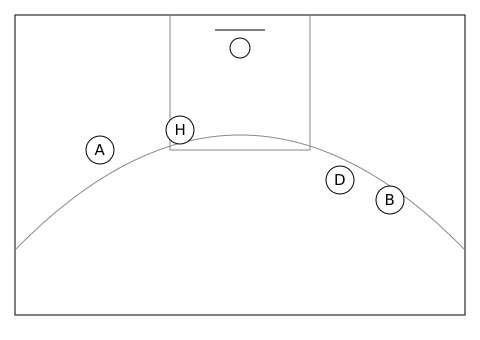
Ask H to point to the ball and A without turning away from the whole court. If that is not possible, adjust the starting spot. A defender cannot recover to a player they have lost sight of merely because an arrow says to return.
Frame 2: show help, then recover
B walks toward the middle. H shows the permitted help position with no contact, then returns toward A as B passes away. D remains responsible for the ball handler's route. Stop on the receiver's catch and ask which window opened when the helper moved.
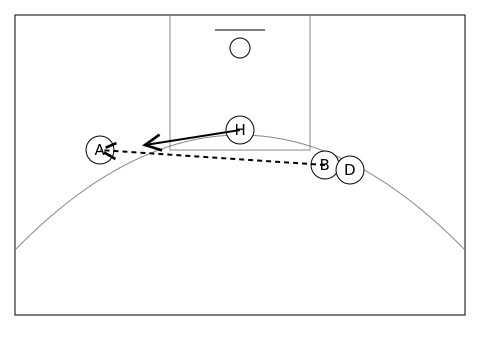
This teaches a handoff decision rather than a trap. A younger program may limit crowding or help in ways the adult must confirm. If the help is not permitted, replace it with an off-ball viewing task while D contains B. Keep the legal lesson separate from the system's name.
Finish a later version with a controlled rebound and outlet. The group should not treat a correct help step as the end of defense. A shot introduces opponents and a loose ball to find. Start that part with a gentle toss and clear collection routes before adding a contested rebound.
How to teach and rehearse a play
Set one outcome
Write a single group task before practice, such as “the inbounder can find the outside outlet when the short pass is covered.” This is observable. “The team will score every time” is not a teaching outcome this session can establish. Give the assisting adults the same task.
Walk the first frame
Place the starting spots, hand over the ball and show who moves first. Ask each player to name their next job. If a player needs another demonstration, repeat it without rushing the rest of the group into live play. A coach can shorten the sequence to one pass and still teach the central choice.
Add one kind of uncertainty
A passive defender can take away a known route. The ball handler then sees why a fallback exists. Only after that choice is clear should the defender have more freedom or speed. Adding a new route, faster movement and live contact together makes it hard to know which part failed.
Rotate the learning jobs
Use a fixed rotation through the first passer and receiver positions. A waiting player can watch whether the outlet stayed visible, then join at the next turn. Do not require a made shot to leave a queue. If the rotation creates long waits, divide into smaller no-defense groups with clear lanes.
Keep a useful correction
Describe the action that closed the play: two players filled one spot, the receiver never showed hands or the helper could not see the pass. Choose one fix and repeat the same frame. A vague instruction to “execute better” adds no next action.
Record a group observation rather than personal rankings. The next session can begin with the same decision from the opposite side. That is a purposeful variation, with no claim that the previous session measured long-term improvement. Keep children's names and records off the public worksheets.
Explore team systems
Choose the detailed guide for the task you actually need. Five-out explains outside spacing and refill. Motion offense explains shared movement decisions. The two zone guides show different starting lines and one labeled handoff sequence for each, where zones are permitted. The defense guide begins with containment rather than a full system.
A pick and roll adds a legal-screen decision and needs its own readiness and rule check. An inbound guide narrows the task to getting the ball to an open receiver from a restart. No software is required to use these paper and HTML frames. A digital play creator can be useful for adult storage or sharing, but it cannot decide the group's rules or readiness.
Match a failed possession to the next teaching task
A diagram review can start with the receiver rather than the ball. Ask the receiver where a pass could arrive without crossing another player's route. Then ask the passer to identify that same window. If they point to different places, walk the exchange before adding a defender.
Keep the first attempt slow enough to stop and explain. This checks whether both players understand the picture, rather than whether they can recite a play name.
The first pass never reaches the receiver
Check the starting distance and target before changing the whole play. Walk the receiver into the intended window and let the passer send a calm ball. If it still needs a high throw or a lunge, shorten the setup. A play can be easy to remember and still ask for a pass the group cannot yet make.
Then add the first defender at a known position. Ask the passer to say whether the same window is open. A route that worked without defense may now be closed. The coach's job is to teach that recognition, not demand the no-defense result while ignoring the new person in the lane.
The sequence stops after a covered cut
Show the covered cutter continuing to a clear exit while a teammate offers the next outside angle. Leave the ball with the passer for this walk-through. A player can see the fallback more easily when the adult is not urging an immediate throw. Restart from the same side after the refill, then let a new player begin with the ball.
The group knows the route but misses the decision
Let the passive defender choose between closing the cut and closing the outlet. Keep the routes slow and the ball handler's options limited to those two windows. A correct read may use either pass or keep the ball. Do not turn the exercise into a memory test with one hidden correct answer.
The same player makes every choice
Rotate the starting ball handler after each short sequence. Ask the new player to explain the first look before starting. If they cannot, simplify that look and repeat it. A team pattern is only useful when the group shares it; one player's memory is not evidence that every participant knows the next action.
The activity takes too long to reset
End the practice turn at a clear point, such as the outlet catch. Collect the ball in one place and restore the starting spots before the next group enters. A short visible finish makes rotation easier. Add a later shot or rebound only when its retrieval route will not interrupt the next group.
FAQ
How many plays should a first-time coach teach?
There is no required number here. Begin with one decision the group can understand and a fallback if its first route closes. A single useful action with frequent turns can teach more than several sets that only one player can explain. Add another sequence when it solves a specific observed task.
Should a diagram be followed when the pass is covered?
No. An arrow shows an option in the illustrated situation. The receiver and lane must still be open. Teach the ball handler to keep balance, see the fallback and obey the adopted rules. A forced pass through a defender is not a successful reading simply because it follows the printed line.
Can these frames certify a court or screen distance?
No. They are schematic teaching pictures without scale or clearance claims. Use the governing rulebook and the exact equipment instructions for those facts. Walk the routes in the actual usable space before starting. A neatly printed picture does not remove an obstacle, confirm a legal position or approve a venue.
Choose the next coaching task
Youth Basketball Tips · https://youth-basketball-tips.com/basketball-strategies.html