
Basketball plays and strategy
Motion offense basketball: principles for youth coaches
Motion offense basketball uses shared decisions about spacing and movement instead of a fixed answer for every pass. A coach still needs a few clear rules. Constant movement without an open lane or receiving target can make the floor harder to read.
Begin with usable spacing, a catchable pass and one rule for what the passer does next. This original teaching version uses a pass, a cut through a clear lane and a refill outside. Add a defender to make the return pass optional. Keep the rule set small enough that the group can explain it and apply it from either side.
USA Basketball’s motion-offense lesson connects spacing and movement. A pass in these frames creates a new receiving window instead of ending the passer’s job.
On this page
Motion principles and readiness
Check whether players can stop after a catch and see a teammate without turning away from the whole court. Those actions give movement a purpose. A player who is still chasing every catch may need passing work before a multi-person offense.
The USA Basketball motion-offense reference and foundational curriculum identify team offense as a teaching area. The sequence below is our own example rather than a copied playbook. It does not claim that one arrangement is best for every age or league.
Choose a clear half court and a suitable ball. Use floor markers for three outside spots at first. The player at each spot needs a usable pass to both of the others. If the court is too wide for that group, bring the spots in rather than demand a high looping throw.
Spacing and passing rules
Give the group two starting instructions: keep a clear receiving window and leave room for the next player's movement. A player near the ball can stay wide rather than follow it. A player far from the ball can move into view instead of hiding behind a defender.
Let the ball handler look before the pass. The offense's name should not make the player release into a covered lane. A slow pause that finds an open target can meet the task better than a quick pass to the expected spot.
For this example, only one player cuts through the middle at a time. A second cutter waits until the first leaves. That timing is a teaching rule for this sequence, not a universal definition of motion offense. Say it aloud so every assisting adult uses the same instruction.
Cut and fill decisions
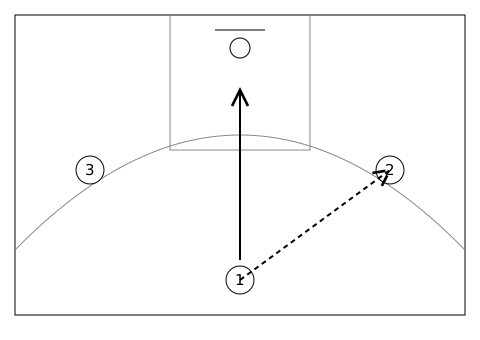
After the cut, the passer exits toward an empty outside spot. The other player fills the vacated top only after the lane clears. Walk the sequence first, freeze at the catch and ask the ball handler where the next pass is available.
Now add one passive defender near the cut. If that defender takes away the middle, the ball handler uses the outside receiver. The cutter still clears the lane. This makes the action a decision rather than an exercise in throwing the same pass regardless of what is there.
For a denied outside receiver, try a short movement away from the blocked window. A backdoor cut can be an option only when the lane and exit are clear. Do not teach it as a command to run behind every defender; the ball handler must be able to see and reach the receiver.
React to a drive
Add a walking drive through one gap while the other players hold clear passing angles. Ask the ball handler to stop if the gap closes. The team can reset outside rather than turn a crowded lane into a required finish.
Choose one response for the first practice. A nearby teammate can remain wide as an outlet while the opposite player keeps the middle clear. Later a program may teach a different fill or drift rule. Don't mix several systems' reactions in the first demonstration.
If an off-ball player runs toward the dribbler, pause and show how the passing angle vanished. Put that player back where the ball handler can see them. The useful observation is whether the drive left a legal next option, not whether everyone moved at once.
A simple teaching progression
Start with three players and no defense. Complete one pass and cut, then stop. Change who begins with the ball. Each player should see the top, the receiving side and the refill before the pace rises.
Add one passive defender whose only job is to close a lane. The ball handler chooses between keeping the ball, reaching the cutter and using the outside pass. End after the catch so the adult can explain the decision without several later actions hiding it.
Then use three-on-three in a clearly marked half court. Let normal scoring give the offense a reason to finish. A practice constraint can ask for a clear receiving window before the attempt, but do not reward a forced extra pass through traffic just to meet a count.
Choose a structure and avoid overload
Check what happens when a cut receives no pass. The cutter still needs a clear route out of the lane, and the next player needs to see the space left behind. Walk that branch before adding another cut. A missed passing window can lead to a calm reset. It does not require a new play call every time the first option closes.
Five-out is one spacing choice inside a broader motion approach. Other versions place a player closer to the basket or use screens. The right teaching choice depends on the group and rules. A name alone does not show whether the players can make its passes.
Keep a short adult record of the group's hardest decision. If cutters stopped in the lane, repeat the exit. If passes arrived late, simplify the receiver's movement. Add a new rule only when it solves a specific problem the group has shown.
FAQ
Is motion offense just constant running?
No. Movement needs to leave a useful passing or finishing option. A player can hold an open spot while another cuts. Teach the timing of that decision rather than praise movement for its own sake. A crowded floor with five moving players can be less readable than a calm, spaced start.
Should a coach install every option together?
No. A small rule set lets the group explain what happens after the pass. Add a defender before adding several new cuts so players learn when the first option is closed. Later choices should solve a visible problem, with the same source-labeled rules and clear-space checks used elsewhere in practice.
Choose the next coaching task
Youth Basketball Tips · https://youth-basketball-tips.com/motion-offense-basketball/