
Hoops, balls and training gear
High school basketball hoop height: regulation and youth adjustments
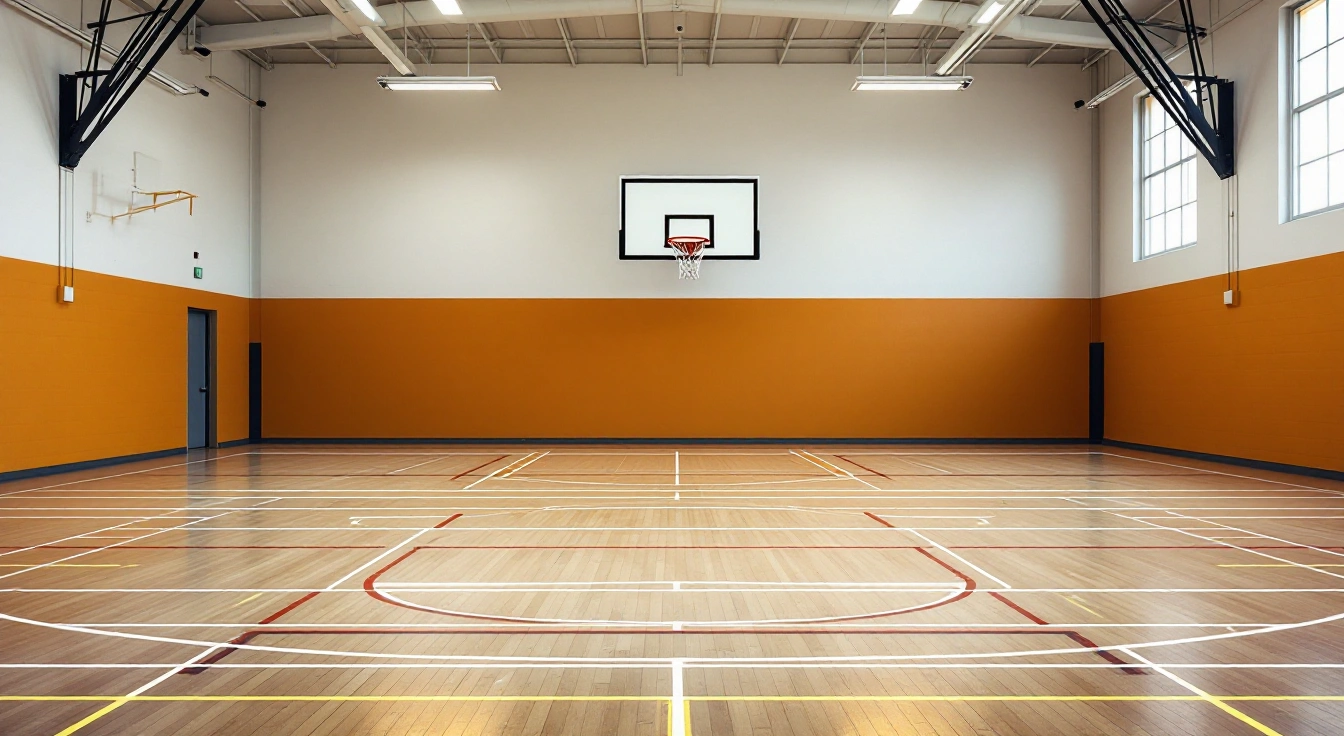
High school basketball hoop height is usually called 10 feet. Measure to the upper edge of the ring from the playing floor, not to the bottom of the net or the top of the backboard. Ask the school which rules it uses. A guide cannot approve a court.
A 10-foot ring height equals 120 inches or 3.048 meters. NBA Rule 1 explicitly states that height to the upper edge of the ring. The NBA/USA Basketball ages 12-to-14 youth chart also gives a 10-foot basket setting. Those are labeled references here; they do not replace the school league's own current gear rule or the exact hoop's setup guide.
NBA Rule 1 places the upper edge of the ring 10 feet above the floor. The youth recommendations use 8 feet at ages 7–8 and 9 feet at ages 9–11, so an adult-height basket is not the starting setting for every group.
On this page
Regulation height and point to measure
The word “hoop” may mean the ring or the whole system. A height claim needs a stated point. The net hangs below the ring and its bottom is not a reliable measure. Backboard dimensions likewise do not tell you where the ring sits above the floor.
The conversion uses 12 inches per foot and 0.3048 meters per foot. Ten feet multiplied by those factors gives 120 inches and 3.048 meters. A setting rounded to 3.05 meters is a rounded description; keep the original source figure when recording a height.
This page does not reproduce a current NFHS gear rulebook section whose full text was unavailable in the public source set. For a school game, have the organizer check the adopted rule and facility height. Don't claim that a general guide has inspected or approved the basket.
Original rim-height diagram
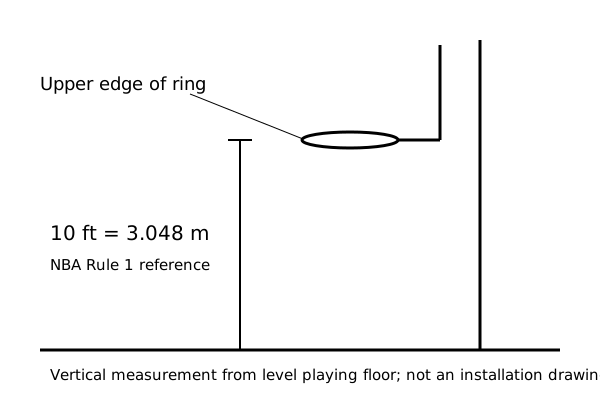
The vertical line shows the height. The floor under the ring supplies the level to measure from. A sloped driveway or uneven surface can make a casual tape reading misleading. Follow the system maker's permitted setup and adjustment method, and leave gear checks to the adult in charge or facility operator.
Never ask a child to climb the support or hang from a ring to check a setting. Don't improvise a measuring method that needs someone to balance under moving gear. This reference explains the point being measured; it is not a procedure for adjusting or maintaining a particular hoop.
Youth guidance versus league rules
| Named source category | Basket height in source | How to use it |
|---|---|---|
| NBA/USA Basketball 7-8 | 8 ft | Age-specific recommendation |
| NBA/USA Basketball 9-11 | 9 ft | Age-specific recommendation |
| NBA/USA Basketball 12-14 | 10 ft | Age-specific recommendation |
| Your school or youth league | Confirm its rule | Do not infer from age alone |
Scroll for more →
A younger program may use a reduced height, while an older group may use the full setting. Read those choices with the ball size and court guidance. For an outdoor session, use our outdoor basketball comparison to check the cover and exact ball size separately from the rim setting. A full-height ring is not a readiness test. If players must throw with a strained motion to reach it, a no-hoop target or another skill can keep the session useful.
An age recommendation is not a demand to alter a fixed school basket. Ask the venue whether adjustment is allowed and who performs it. Don't change shared gear without that permission. A low target elsewhere can serve a beginner activity without modifying the game basket.
Adjustable-hoop selection questions
Before comparing products, check the needed setting range, the actual playing surface and the available clear space. An advertised height range does not establish how it is fixed or where it can be used for a particular driveway. Check the official manual for the exact model and revision.
Ask whether the stated setting is measured to the ring's upper edge. Confirm the height control's adult-use instructions and how the system is secured at the selected height. A product photo cannot show all of those conditions. No particular hoop model is recommended or tested on this reference page.
For practice planning, check the setting before assigning groups to a basket. Two baskets in the same gym can be set at different heights. Tell the assisting adult which one is being used for the task. If the height is unknown, don't record a made or missed attempt as if it came from a known regulation distance and height.
Confirm your program’s rim setting
The NBA rule and youth gear charts describe different settings. The diagram is original artwork derived from the stated point to measure and exact unit math. It is not a photo of an inspected facility or a building plan from a maker.
Keep the program's rule with the session materials. High school basketball hoop height is a useful search answer, but the adult preparing a game still needs the actual adopted code and a known setup. Mark an unchecked local setting unknown until the organizer resolves it.
FAQ
Does the net's length alter the ring-height figure?
No. The height reference is the top edge of the ring. A net hangs below it and can move, stretch or be replaced. Use the ring reference when you ask the venue about its setting. Don't estimate a hoop's height from where the net ends in a photo.
Can a coach infer the height from a product name?
No. Ask what setting the actual system uses today. A model with a range of settings may be left at a lower one. Its name or photo does not prove the present height. Record the known setting and let the adult in charge at the venue handle any permitted adjustment.
Does a printed diagram prove the basket is level?
No. The diagram explains which points the figure joins. It does not inspect the floor, mounting or ring. The venue operator needs the actual gear instructions and relevant rules. Keep an unknown field unknown until that check is complete; a neat drawing cannot supply the missing fact.
Youth Basketball Tips · https://youth-basketball-tips.com/best-outdoor-basketball/high-school-basketball-hoop-height/