
Practice plans and coaching
Basketball practice plan: a runnable session and printable worksheet
A basketball practice plan works when the coach can start each block without a second explanation. This example has one main task: receive a pass with balance, then choose a pass or a close shot. Use the times as a starting sheet, and cut a block when the group needs a pause.
Short answer: this is an editable 60-minute session for roughly 8 to 12 beginners who can follow a stop cue. It includes five minutes of water and transitions, close-range work and a small-sided game. Use the 45-minute version if the booking is shorter. The schedule is an original coaching example, not an official minimum, fitness plan or promise of progress.
The NBA/USA Basketball participation guidance separates age bands. Choose the applicable band before adapting the session length; the planner’s activity splits are original examples.
On this page
Choose the group and check the equipment
Check the booking, court surface and usable baskets before choosing the plan. Ask the organizer which rules and supervision arrangements apply. A large group at one basket needs parallel tasks. A small group needs fewer stations and more space between pairs.
The NBA and USA Basketball participation table gives practice-length guidance by age. It lists 30 to 60 minutes for ages 7 to 8, 45 to 75 for ages 9 to 11, and 60 to 90 for ages 12 to 14. These ranges are guidance, not permission to fill every minute with hard activity. Other basketball in the week matters too. This sheet does not assess a child's readiness or weekly load.
Use a ball each where possible. Otherwise work in pairs and exchange the ball often. Choose floor spots that won't slide or trip a player. A basket that forces a beginner to heave the ball is a reason to teach passing or use a reachable target instead.
Write a single observation at the top of the sheet: “Can the receiver catch with balance and look before acting?” That is more useful than a list of ten faults. Tell any assisting adult the same cue, so players hear a clear message.
Build a session for your group
Choose a session, then edit its minutes
The default is a 60-minute beginner session with one basket. Use the controls to select a shorter plan or change its task. These are original teaching examples. Use the named age guidance when choosing a length. The choice does not assess readiness or weekly workload.
Equipment: manageable balls and flat markers, with clear lanes and water access. Check the floor and local rules first. Keep groups small enough for the adults to supervise. With one basket, place the passing task outside the shot and return routes. With no basket, use a floor target instead of a shot.
Ages 7-8: NBA and USA Basketball participation guidance lists 30-60 minutes per practice. Guidance is not a demand to fill the time.
Preset: 60 minutes. Group: beginner who can stop and receive. Goal: receive, then choose. Baskets: one; alternate groups.
Watch whether the group receives with balance and looks before the next action.
60 minutes total, including 5 minutes for water and resets.
| Elapsed | Minutes | Activity | Setup and rotation | Cue |
|---|---|---|---|---|
| 0-6 | 6 | Arrival and stops | Pairs in separate walking lanes | Stop with space |
| 6-14 | 8 | Control and scan | Separate dribble lanes; allow a catch between bounces | See the adult before moving |
| 14-16 | 2 | Water and reset | Supervised move between tasks | Park balls; walk to water |
| 16-26 | 10 | Pass and receive | Pairs, then a third ready receiver | Show ready hands |
| 26-36 | 10 | Close target task | One basket group; others pass away from the rebound route; swap halfway | Wait for a clear landing spot |
| 36-39 | 3 | Water and game setup | Adult explains one game cue | Listen with still balls |
| 39-55 | 16 | Small group choices | Two-on-one with a walking defender; rotate jobs | Find a free teammate |
| 55-60 | 5 | Review and close | Return balls and name a group observation | Choose one task to repeat |
Scroll for more →
The session splits are editable Youth Basketball Tips examples. Include water and station resets in the total.
Changes stay on this page while it is open. Nothing is sent or saved. Printing the edited session prints this table; the PDF link below remains the fixed example and blank worksheet.
A 60-minute example practice
The rows total 60 minutes, including arrival, water, movement between stations and the close. Start and end are elapsed minutes, not a demand to keep a child working to a clock.
| Elapsed minutes | Duration | Activity | Setup and rotation | Coach cue |
|---|---|---|---|---|
| 0-6 | 6 | Arrive, move and stop | Pairs share a lane; one ball per pair | Walk, then stop with space |
| 6-14 | 8 | Control and scan | Individual dribbling in separate lanes | Look up before the next bounce |
| 14-16 | 2 | Water and reset | Balls parked beside the coach | Walk to the next spot |
| 16-26 | 10 | Pass, receive and move | Groups of three at triangle markers | Show hands before the pass |
| 26-36 | 10 | Close-range finishing | Two shooting groups if baskets allow | Land in the same clear lane |
| 36-39 | 3 | Water and game setup | Explain one scoring constraint | Listen with the ball still |
| 39-55 | 16 | Three-on-three decisions | Short games; rotate resting group | Find a free teammate |
| 55-60 | 5 | Review and calm close | Whole group; no player rankings | Name the next team task |
Scroll for more →
How each block runs
Arrival and controlled movement
Mark separate lanes before anyone starts. Ask pairs to walk out and back, stop at the end, and leave room for the next pair. Add a sideways walk only after they can follow the direction. This is a chance to find loose equipment or a crowded route before balls are bouncing.
Give the stop cue once and wait for still balls. If you must repeat it over noise, make the groups smaller or move them farther apart. Don't punish a missed cue with extra running. Rehearse the cue in the space where it will be used.
Ball control with a reason to look up
Let players dribble in their own lane at walking speed. An adult shows a hand signal at the far end. Players call what they see, keep the ball near their body and stop before returning. A player who loses the ball waits for a clear route to collect it.
For a first attempt, allow a catch between bounces. For a ready group, ask for the other hand on the return trip. Don't add a defender, speed and a new hand at once. Observe whether looking away from the ball causes a loss of control, then adjust the task.
Pass, receive and leave space
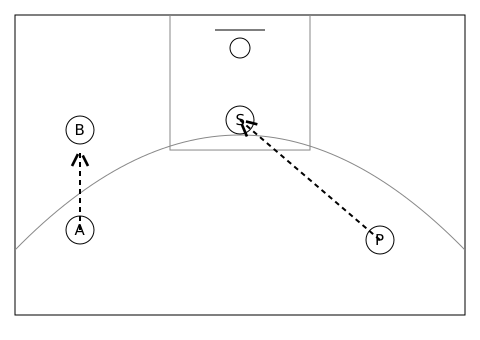
Put three markers in a wide triangle. The passer sends a catchable chest or bounce pass, walks toward the empty side and stops. The receiver shows a target and looks after the catch before choosing the next pass. Keep the ball out of a crowded middle.
An adult can stand beside a passing lane without trying to intercept. The passer then has to choose a clear line rather than repeat a fixed direction. If catches are rushed, remove the adult and shorten the distance. The purpose is to notice the receiver, not to throw faster.
Finishing near the basket
Use one small group for each available basket. One player shoots from a comfortable close spot; another waits outside the landing area. The shooter collects the rebound only when the space is clear, passes to the next player and exits by the side. Don't send two shots toward the same rim at once.
Keep the first version still and balanced. A player ready for movement can receive a short pass before the attempt. Ask an adult to watch where feet land, not just whether the shot goes in. A miss with a calm finish may meet the task better than a wild made shot.
Three-on-three with one instruction
Use a half court and one ball. Ask the attacking group to show a passing option away from the ball. Play a short possession, then restart from a marked spot. Swap the resting group in after a brief agreed interval, even when one team has just scored.
For uneven numbers, rotate one player at every dead ball in a fixed order. Give that waiting player a single task, such as naming an open space, rather than leaving them in a long queue. These are modified teaching games, not official FIBA 3x3 competition rules.
A 45-minute adaptation
Shorten the practice by removing repetitions, not the water breaks or the close. Keep the receiving task in each retained block. The total below is 45 minutes.
| Block | Minutes | Keep this task |
|---|---|---|
| Arrival and movement | 5 | Clear stops |
| Ball control | 6 | Look up in a clear lane |
| Water and move | 2 | Still balls |
| Passing | 8 | Catch before acting |
| Close finishing | 7 | Clear landing area |
| Water and game setup | 2 | One instruction |
| Small-sided game | 11 | Show a passing option |
| Review | 4 | Choose what to repeat |
Scroll for more →
Adjust for one basket or uneven numbers
With one basket, split the group into finishing and no-hoop passing areas. Keep the passing area outside the shot and rebound route. Exchange groups at the midpoint of the finishing block. The players away from the basket still work on the same receiving decision.
With very few balls, make pairs with one working and one watching for the agreed cue. Swap after each short turn. A watcher should be able to say “the receiver was ready” or “the ball came too high.” Avoid long feedback speeches from peers.
If attendance is much higher than expected, reduce the number working at once in each lane and use another supervised space. A cramped drill does not become suitable because the schedule says to run it. If you cannot maintain clear routes, replace the moving task with a still passing activity.
For mixed readiness, keep the same goal and offer two versions. One pair can catch between bounces; another can travel with a live dribble. Let players move between versions without public labels or rankings. Ask whether the task gives them a useful next decision.
Blank printable practice worksheet
The download contains this schedule and a blank planning page. Keep only group-level observations. There are no name, birthday, roster or individual score fields. Pencil entries stay on your own paper; nothing is submitted to this site.
Download the practice plan PDF. Version 1, two pages, US Letter, also printable on A4 using fit to printable area. The HTML table is the full readable alternative. Use your browser's print command for this page.
| Block | Minutes | Setup or rotation | Cue and group observation |
|---|---|---|---|
| ________________ | ______ | ________________ | ________________ |
| ________________ | ______ | ________________ | ________________ |
| ________________ | ______ | ________________ | ________________ |
| ________________ | ______ | ________________ | ________________ |
| ________________ | ______ | ________________ | ________________ |
| ________________ | ______ | ________________ | ________________ |
Scroll for more →
Review the session and plan the next one
After the close, write what the group could actually do. “Pairs caught before moving” is an observation. “Everyone will play better next week” is a prediction. Keep the former and leave out the latter.
Pick the first task for the next session from the hardest transition today. If passing broke down when a defender appeared, repeat the pass with a slower defender. If players waited too long, alter the rotation before adding a new skill. The useful basketball practice plan is the one you can explain and adjust on the floor.
Station layout
FAQ
Does changing the planner alter the downloadable PDF?
The PDF remains the fixed example with a blank worksheet. Print the edited session from the planner to keep your current choices. Its real total appears above the rows. Browser changes stay only in the open page and disappear when you reload it.
What if the group needs more time for water?
Change the break row and read the new total. Shorten another activity or end earlier when needed. Do not hide water or station changes outside the booking. The example time is a planning choice, not a demand to work continuously.
Choose the next coaching task
Youth Basketball Tips · https://youth-basketball-tips.com/basketball-practice-plan/