
Practice plans and coaching
Kindergarten basketball practice plan: a flexible first session
A kindergarten basketball practice plan needs short instructions, room to move and an easy way to stop. Use this 30-minute example for an adult-led introduction to moving with a ball. Keep the game small enough that you can see every participant and shorten it when attention fades.
This authored session starts without a hoop. Children walk and freeze, roll to a partner, send a ball toward a reachable target, then repeat a favorite activity. The times include water and tidying. They are editable examples, not an official preschool practice standard. Adult supervision, facility rules and the group's response determine what you can run that day.
The NBA/USA Basketball practice-duration table starts at ages 7–8. It supplies no kindergarten duration, so the short sessions below are editable teaching examples, not an under-7 workload standard.
On this page
Readiness, supervision and equipment
Meet the adult organizer before the session. Agree who handles arrivals, toilet trips and the closing handover. Keep the teaching adult available to watch the activity rather than leaving the court to find equipment. Follow the venue's supervision policy; this page sets no adult-to-child ratio.
The published NBA and USA Basketball age tables begin at ages 7 to 8. Don't apply that age bracket's basket height or practice length to kindergarten as if it were a rule. A floor target and a ball that the child can hold comfortably can serve the introductory task here. Ask the local program about its equipment policy.
Use a clear dry patch of floor with no loose chairs or bags in the travel route. Check that floor spots won't slide. A rolled ball needs room to slow down without sending a child through another activity. Keep spare balls contained beside an adult.
Watch the first walk-and-stop attempt. Can the group stay in the area and pause at a simple cue? If not, reduce the space, repeat the cue with an adult or keep the activity still. The next block is optional; reaching the last row is not the goal.
A flexible 30-minute example
The table totals 30 minutes. Water and the time to settle again are part of that total. Each block can end early. The two minutes at the close are for a calm finish and the program's handover routine, not another competition.
| Elapsed minutes | Duration | Activity | Setup | Cue |
|---|---|---|---|---|
| 0-4 | 4 | Welcome and space check | Each child beside a floor spot | Walk to a free spot |
| 4-9 | 5 | Move and freeze | No ball at first; adult shows movement | Stop before the next player |
| 9-11 | 2 | Water and settle | Balls remain in the activity area | Walk with an adult |
| 11-17 | 6 | Roll and collect | Pairs use a short clear lane | Roll to waiting hands |
| 17-23 | 6 | Reachable target game | Floor or low target; take turns | Look, then send the ball |
| 23-25 | 2 | Water and tidy | Adults collect loose balls | Stop before you fetch |
| 25-28 | 3 | Group follow-and-stop | All move in the same direction | Copy the slow leader |
| 28-30 | 2 | Closing choice | Ask which activity to repeat | Use one short answer |
Scroll for more →
Movement and ball-familiarity blocks
Walk, find a spot and freeze
Place floor spots with enough space for outstretched arms. Show the whole task once: walk to a free spot, stand still, then look at the adult. Let the group copy at a slow pace. Move all players in the same direction so paths don't cross.
Begin without a ball. Add a held ball only if the group can already stop. A ball held at the waist is enough; bouncing is not a condition for taking part. If the group chases loose balls, collect them and return to the no-ball version.
Use one cue, such as “find a space.” Don't call several body instructions while children are still moving. Ask an assisting adult to model the stop rather than correct each child aloud. Repeat a short round and decide after a pause if another is useful.
Meet the ball while standing still
At a floor spot, let each participant hold a ball and set it down after turning it. An adult shows how to pick it up with two hands and keep it close. There is no need to copy an adult dribble. Rolling around a spot or passing hand to hand may be the useful first task.
Use a softer or smaller suitable ball if the program permits one. Check that the child can carry it without blocking their view of the floor. Don't use weighted equipment or ask for repeated overhead throws. The object is control, not force.
Rolling, catching and targets
Roll to waiting hands
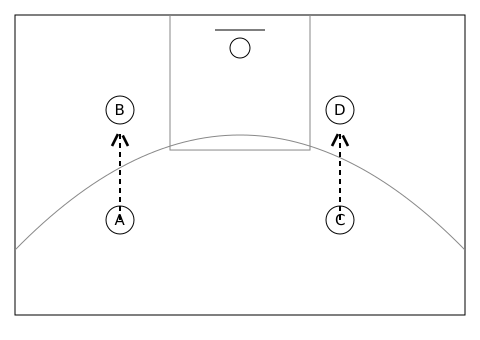
Pairs face each other across a short clear lane. The receiver waits with hands ready near the floor. The sender rolls gently toward the receiver, waits for control and then becomes the receiver. An adult can replace the partner when a pair needs help with the turn-taking.
Start with a distance that allows a slow ball to reach the partner. If it stops halfway, bring the pair closer rather than demand a harder throw. If it goes past the receiver, slow the roll and use a wider target area. Avoid making a child run across other pairs to fetch it.
Once the pair can exchange calmly, let the receiver stand a little farther away. Add only that distance. A faster roll and a moving receiver are separate tasks for another time. Watch whether both partners are getting a turn, not how many exchanges beat another pair.
Send the ball to a reachable target
Use a floor circle, a stable low target or a suitable basket approved by the program. Mark where one player sends the ball and where the next waits. One adult controls the collection route. A target on the floor works when no suitable low hoop is available.
Ask for a gentle roll or two-hand send that the child can repeat without strain. The next person waits until the ball is clear. Move the starting spot closer after repeated wild throws. A target hit is welcome, but a calm attempt and patient turn also meet the activity's purpose.
Avoid a winner-stays format. Let every participant take a turn and choose whether to repeat the same version. A shy player can send to an adult first. The adult should make the return easy to receive, rather than turn each attempt into a test.
Simple group game and close
For follow-and-stop, the adult walks along a clear route and pauses at floor spots. The group follows without racing. The leader can hold a ball and stop with it still; the group copies only when ready. Keep any turn broad enough that the line does not bunch up.
Switch to a circle if the walking route becomes crowded. Each participant can copy a simple held-ball movement at their own spot. There is no elimination for dropping the ball. Use the last turn to repeat one movement the group liked.
At the close, ask for a simple choice between rolling and the target activity. Let children point rather than require a speech. Put equipment away before the adult handover starts. Keep the closing routine predictable even when an earlier activity changed.
No-hoop and shorter-session versions
The complete example works without a hoop. Replace every basket attempt with a floor target and keep the same waiting and retrieval positions. Don't raise the target merely to make the task look more like a regulation game.
For a shorter booking, use 3 minutes of welcome, 4 of movement, 2 for water, 5 of rolling, 4 of target play and 2 for the close. That is a 20-minute authored option. If settling takes longer, remove a turn rather than rush the last handover.
If attention fades halfway through a block, end it. Change one thing, such as the target or the direction, rather than add more rules. If the group is tired or upset, a quiet close can be the right next step. No schedule on this page overrules the supervising adult's judgment or the program's policy.
Print the kindergarten session
Download the kindergarten practice PDF. Version 1 has the example and a blank sheet. The two-page US Letter file can be fitted to A4. The web page retains every activity and timing without JavaScript. Use the print button or your browser menu.
| Activity | Minutes | Adult setup | What the group could do |
|---|---|---|---|
| ________________ | ______ | ________________ | ________________ |
| ________________ | ______ | ________________ | ________________ |
| ________________ | ______ | ________________ | ________________ |
| ________________ | ______ | ________________ | ________________ |
| ________________ | ______ | ________________ | ________________ |
Scroll for more →
Record only a group-level observation such as “the roll stayed in the lane.” Keep children's names, images and individual performance off this worksheet. A useful next kindergarten basketball practice plan can repeat the same rolling game with a calmer collection route.
Station layout
FAQ
Is completing all 30 minutes the goal?
No. The group’s ability to follow the next task matters more than filling the schedule. Pause or end a block when control or attention drops. The shorter version keeps a calm close. Do not turn an unfinished activity into a penalty or a demand for more running.
Can the session work without a hoop?
Use the rolling and floor-target versions. Keep the sending lane and return route clear, and let an adult control loose-ball collection. A low target is useful only when its setup is suitable. A hoop is not needed for the movement and turn-taking tasks.
Choose the next coaching task
Youth Basketball Tips · https://youth-basketball-tips.com/basketball-practice-plan/kindergarten-basketball-practice-plan/