
Practice plans and coaching
Middle school basketball practice plan: skills into small-sided play
A middle school basketball practice plan can connect skill work to a game decision without adding a long playbook. This example teaches one question: after pressure arrives, where is the next open pass? Use the same question in the stations and the final game so the group can see the link.
The schedule is an authored 60-minute example for about 10 to 12 players, two baskets and an adult-led group with basic dribbling and receiving skills. Water and transitions are included. A 45-minute version and one-basket rotation follow. The plan does not assess fitness, set a weekly training load or promise a competitive result.
The NBA/USA Basketball participation guidance separates ages 9–11 from 12–14. Check the group’s actual band and competition schedule before choosing one of these session examples.
On this page
Choose a skill objective and group assumptions
Start with what the players can do today. Can they keep a dribble while looking for a teammate? Check that they can pass without stepping into another lane. If either task is new, take the defender out of the first station. Middle school is an age setting, not a skill level.
Ask the program which defensive tactics and contact rules are permitted. A teaching plan may show a help position while the local competition uses different restrictions. Name that distinction before practice. Let the venue and program rules set the boundaries for the activities you choose.
Arrange balls, flat markers and two separate station spaces. Leave the routes to water clear. An assistant can manage one station; without an assistant, reduce the number of simultaneous tasks so the coaching adult can see them. Never use a diagram as proof that a crowded space is suitable.
A 60-minute example schedule
Elapsed times below add to 60 minutes. The five minutes labeled water include moving equipment and explaining the next task. If a block overruns, shorten a later repetition and preserve the breaks and closing review.
| Elapsed minutes | Duration | Task | Setup | Cue |
|---|---|---|---|---|
| 0-7 | 7 | Movement with decisions | Pairs; marked travel lanes | See the space before you move |
| 7-17 | 10 | Ball pressure and escape | Three-player groups; controlled defender | Protect, then find an outlet |
| 17-19 | 2 | Water and station reset | Balls off travel routes | Walk to your next group |
| 19-29 | 10 | Pass, cut and refill | Triangles, then a passive defender | Clear the lane after the pass |
| 29-39 | 10 | Help-and-recover teaching | Half court, five walking positions | See ball and your player |
| 39-42 | 3 | Water and game briefing | Explain the observation task | Ask one player to repeat it |
| 42-56 | 14 | Small-sided decision game | Three-on-three; short rotations | Pass toward an open window |
| 56-60 | 4 | Review and next session | Anonymous group observations | Say what the defense allowed |
Scroll for more →
Decision-skill stations
Pressure, escape and outlet
Set a small working area with an attacker, a controlled defender and an outlet. The attacker begins with the ball. The defender shades one side at walking pace; the attacker dribbles away from that side and finds the outlet. End the turn on the catch, then exchange duties.
This is a reading task before it is a contest. Ask the defender to keep hands back for the first round. If the attacker turns away and loses sight of the outlet, widen the area or return to no defense. Only add legal live pressure when all three players understand the routes.
Give the outlet a job too: move to a clear passing window rather than stand behind the defender. Watch the angle, not a running total of steals. A short pass that the teammate can catch meets the task better than a long escape throw.
Pass, cut and refill
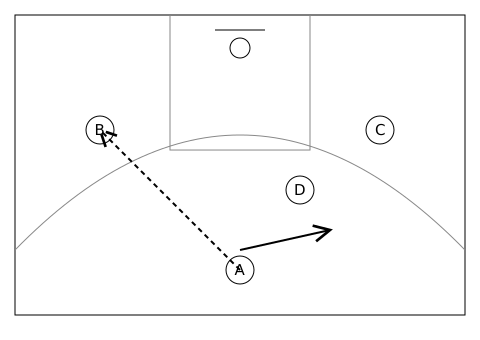
Use three perimeter spots. A passes to B, cuts through the open middle and leaves by the far side. C fills the space A left only after the cut clears. The next pass restarts the same decision from a different spot. Begin without a defender so the group can see the sequence.
Add one passive defender near the cutting lane. B now keeps the ball if the lane is closed and uses the open perimeter pass. Do not reward a forced pass because the drill's name says “cut.” The useful decision may be to hold space and wait.
For a ready group, let the cutter return to any clear outside spot. For a group that crowds the lane, keep the floor markers and pause after each cut. The goal is that a passer has somewhere useful to go without dragging another teammate into traffic.
Teach one team concept
Use the ten-minute teaching block for help and recovery, not several defensive systems. Put a ball handler on a wing, a marked cutter away from the ball and a helper between them. Walk a drive toward the lane. The helper stops the route, then returns toward the assigned player as the ball leaves.
Freeze the walk-through before contact. Ask each defender to point to the ball and the player they are responsible for. If someone cannot name both, reset the positions rather than add speed. Rotate every player through the helper's position.
The concept is an authored teaching setup. It does not decide a local league's legal help, double-team or zone rules. Check those first. If help is restricted for the group, replace this block with containing a dribbler one-on-one.
Small-sided play and feedback
Use three attackers and three defenders on a half court. Start from the top with a checked ball and a clear possession boundary. Ask attackers to keep a usable outlet when the ball goes toward a sideline. Keep the scoring normal enough that players still have a reason to finish near the basket.
Rotate resting players in a fixed order at dead balls or short intervals. Don't make the losing group sit until the stronger group chooses to stop. With an odd number, an adult can manage an outlet-only position, provided it fits the space and everyone understands its limits.
Pause after a possession that shows the day's question. Ask where the next pass was open. Take one answer, move the group into that spot and restart. Long speeches can erase the decision the players just saw. Give brief feedback that describes the actual opening or closed lane.
45-minute and one-basket adaptations
For 45 minutes, use 5 for movement, 7 for pressure and outlet, 2 for water, 7 for pass-and-cut, 7 for the team concept, 2 for water and setup, 12 for the game and 3 for the close. Those blocks sum to 45. Keep fewer attempts in each station rather than speeding every attempt up.
With one basket, put ball-pressure work in a separate no-shot space. Use the basket for passing and finishing decisions, then switch groups. Keep the travel route outside the rebound area. The final game can use brief turns with a resting group doing a calm no-ball spacing walk-through.
For mixed readiness, a beginner uses a passive defender while a ready player faces a defender allowed to intercept a pass. Keep the goal identical: see and reach a clear outlet. Don't use a player's size as a reason to keep them permanently near the rim.
Print the session
Download the middle school practice PDF. Version 1, two US Letter pages with an A4 fit option, includes the completed schedule and a blank page. The HTML is the full no-JavaScript version. Print one copy for each adult who runs a station.
| Block and duration | Setup | Decision cue | Anonymous group observation |
|---|---|---|---|
| ________________ | ________________ | ________________ | ________________ |
| ________________ | ________________ | ________________ | ________________ |
| ________________ | ________________ | ________________ | ________________ |
| ________________ | ________________ | ________________ | ________________ |
| ________________ | ________________ | ________________ | ________________ |
Scroll for more →
End by asking which outlet was easiest to find and why. Record the court condition or task that made it easy, with no child names or personal records. If the answer was simply that the defender stood still, the next middle school basketball practice plan can add a moving defender while leaving every other constraint familiar.
Station layout
FAQ
Should the game use every defensive option older players see on television?
Use the program’s adopted rules. Check what it permits for screens and pressing before planning either. Age alone does not establish readiness for added pressure. A walking defender can make a useful decision task while keeping the catch and next pass clear.
How should an assistant review a station?
Give the assistant the same one-task cue as the lead adult. Ask for a group-level observation, such as whether the receiver looked before passing. Use that to choose the next setup. Do not collect individual child scores or publish player comparisons.
Choose the next coaching task
Youth Basketball Tips · https://youth-basketball-tips.com/basketball-practice-plan/middle-school-basketball-practice-plan/