
Basketball plays and strategy
5 out offense: spacing, cuts and decisions
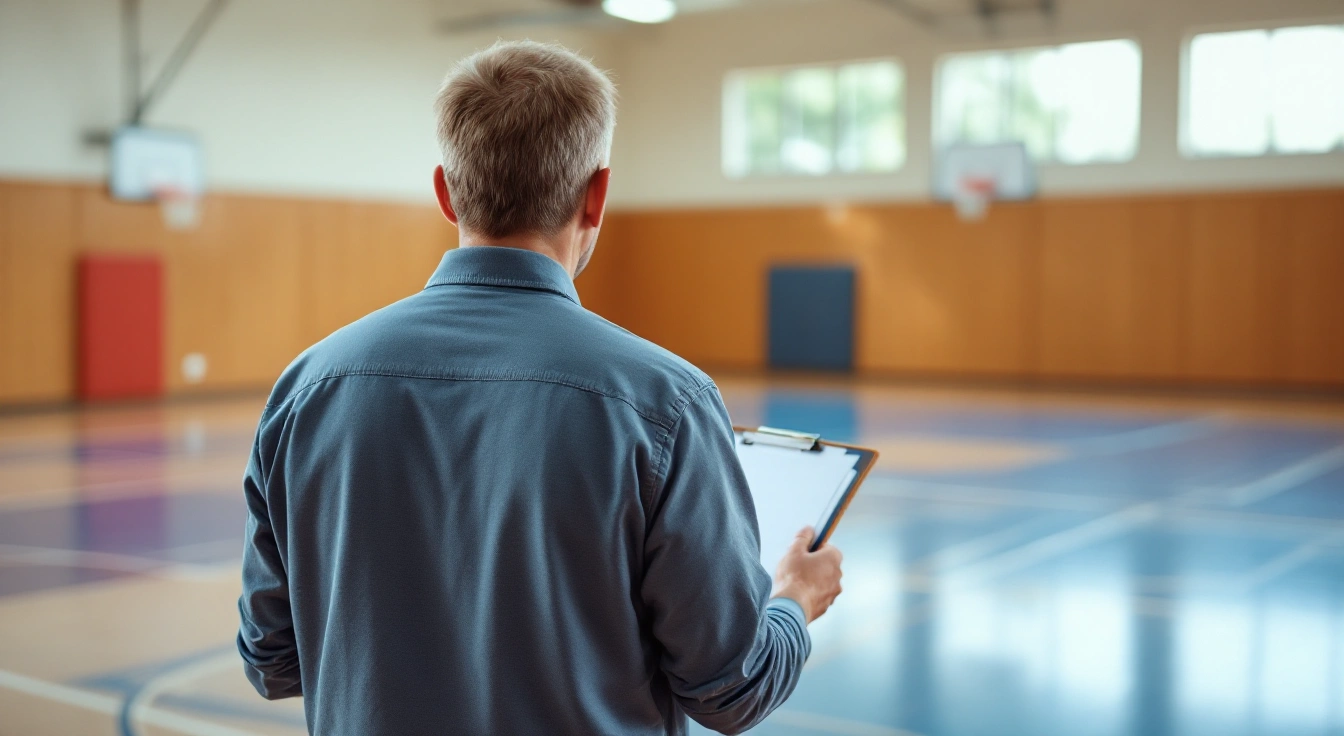
A 5 out offense places all five attackers outside the lane at the start, leaving room for cuts and drives. Its name describes spacing, not a promise that everyone must shoot long shots. Teach where the next open spot is before adding several movement rules.
Begin with a top player, two wings and two corners. In this original example, a pass is followed by a cut through an open lane, then teammates fill the spaces left behind. If the cut is covered, keep the ball outside and use another option. Use the sequence as an adult teaching plan, not an official system that every age group should run.
In USA Basketball’s motion-offense guidance, spacing and movement work together. Keep a visible passing window when a teammate cuts.
On this page
Start with spacing and readiness
The group needs to catch with balance and see a nearby teammate before five-player movement is useful. If those tasks are still new, start with three attackers and no defenders. Keep the same idea of space without asking a beginner to remember four moving teammates.
Choose an outside distance that suits the court and players. Five-out does not require every starting spot to sit beyond an adult three-point arc. A corner player who cannot make a controlled pass from that spot needs a shorter distance or a simpler task. Do not confuse a spacing label with an equipment or age rule.
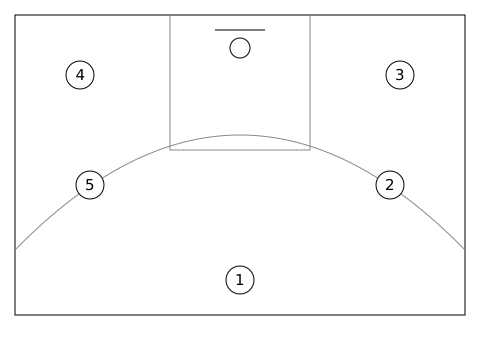
Tell the group which way the basket sits in the diagram. The top edge is the baseline. Numbers identify temporary positions and rotate during practice; they are not permanent positions assigned by height or ability. Everyone should learn the pass and the movement away from the ball.
Five starting positions
| Position | First job | What to see |
|---|---|---|
| 1, top with ball | Look for a clear wing pass | Receiver ready before release |
| 2, right wing | Offer a catchable target | Open lane beyond the catch |
| 3, right corner | Keep width | Do not follow the ball into 2 |
| 4, left corner | Leave room for the cut exit | Space up the left side |
| 5, left wing | Wait to fill the top | Cutter has cleared first |
Scroll for more →
Give the players a moment to point at their neighboring spots. If a player does not know where to go after a pass, walk it once without the ball. The floor spots can stay for the first round, then come away when the group recognizes the space without them.
Pass, cut and fill
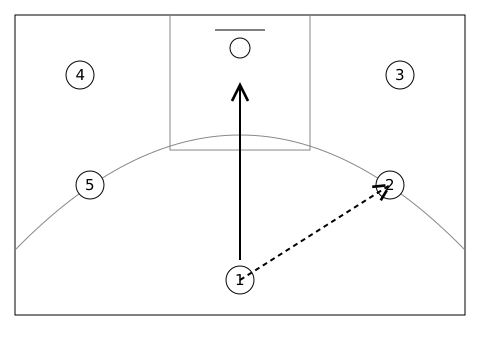
In frame 2, 1 passes to 2 and cuts toward the basket only if the lane is clear. The cut is an option to receive, not an order for 2 to force the return pass. Player 3 stays wide to leave a driving or passing window on the right.
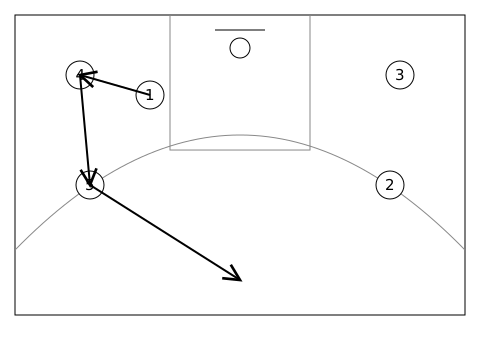
After 1 clears the lane, 5 moves toward the top, 4 moves up to the left wing and 1 exits toward the left corner. These moves follow each other; they are not a signal for three players to sprint into one spot. Keep the pace slow until the group can say who fills each space.
Restart with a pass from 2 to the newly filled top. The same reading now happens from a different angle. For the first teaching version, stop after one successful refill and exchange starting positions. That gives every player a clear turn at the first decision.
Drive and react
Teach the drive only after the pass-and-cut pattern makes sense. Let 2 walk toward an open gap while the other four players keep clear passing angles. If a teammate is already in that lane, 2 waits or uses the pass. The name of the offense does not give the ball handler priority over another person's landing space.
Choose one reaction for the first lesson. For example, the near corner can stay wide while the opposite wing remains available for a return pass. A full system may use different movement rules. Label this as one authored choice so assisting adults do not give conflicting instructions.
Add a passive defender at the gap. Ask the ball handler to see whether the route remains open. A defender stepping into it can make an outside pass the correct answer. Do not score the exercise only for a drive that reaches the rim, since that would reward ignoring the decision.
Common spacing errors
If two players fill the same space, pause and restore the five spots. Ask which space the cutter left and which player was nearest to fill it. Make one correction to the sequence, then repeat the same side before switching the starting pass.
If the corner follows the ball toward the wing, show the gap that disappears. Move the corner back to a usable passing position and restart. If the top fills before the cutter leaves, slow the timing rather than add a new cutting rule.
If every catch becomes a rushed long shot, bring the spots closer or use a task where a controlled close finish is the only shot. Label that as a practice constraint, not the competition's scoring rule. Five-out spacing can teach seeing space without becoming a three-point shooting contest.
Teach the rules in small-sided play
An original ten-minute teaching block can use three minutes of no-ball walking, three of pass-and-cut with no defense, and four of three-on-three choices. Those are editable example times. Water and transitions belong in the full session plan rather than outside its total.
For three-on-three, keep a top and two wide spots. A passer can cut and leave through an empty outside area while the remaining player fills. A defender who blocks the cut should make the passer choose another route. Do not force all five-player positions onto the small game.
Observe whether the ball handler can name an open teammate and whether the lane clears after the cut. These are group teaching observations, not individual performance profiles. Keep the next practice focused on the decision that failed most often, with no guaranteed scoring outcome.
A three-possession teaching check
When the pass-and-cut action stalls, check the space the cutter is about to enter. Ask the player already there to show a clear exit route before replaying the pass. Then watch whether the cutter leaves the lane after the window closes. A useful reset keeps a new passing lane open. It does not require the ball handler to force the first planned pass or make every player cut at once.
This original check varies the defender's choice while leaving the starting positions familiar. In the first possession, leave the cut open and let the receiver choose it. End on the controlled catch near the basket, before adding a rushed finish. Ask which outside players kept that lane clear.
In the second possession, a passive defender closes the middle. The cutter leaves through the planned exit and the ball handler looks to the filled top. The outside pass is now the useful answer. Don't reward a forced return simply because the first possession used it.
In the third possession, let the defender decide which window to close. The ball handler must look before choosing, while the others keep usable space. Stop after a catch or a deliberate hold with no open pass. The group should be able to explain why the answer differed.
Rotate the starting ball handler through the group. Keep the defender passive until the receiving and refill jobs remain clear from both sides. A made basket is not required to move on to another player's turn. The check observes a decision under these conditions, not a season-long scoring effect.
If all three possessions collapse into the same crowded lane, remove the defender and restore the exit timing. More rules will not repair a missing first movement. Keep the next practice focused on the one space the group could not keep open.
FAQ
Must all five players be good three-point shooters?
No. The starting label means players begin outside the lane. A beginner version can use shorter spacing and seek a close finish. The distances must still leave useful passing and movement windows. Do not put a player beyond their controlled passing range just to match a professional-looking diagram.
Should a covered cutter still receive the ball?
No. The pass is an option only when the window is open. A ball handler who keeps the ball and finds another teammate can be reading the task correctly. Teach the cutter to clear the lane and refill rather than stand near the rim waiting for a forced pass.
Choose the next coaching task
Youth Basketball Tips · https://youth-basketball-tips.com/5-out-offense/