
Basketball plays and strategy
Youth basketball inbound plays: simple diagrammed options
Youth basketball inbound plays should give the thrower a clear first option and a fallback. Start with the adopted restart rules and a readable setup. Both examples move a receiver into open space. Neither needs a contact screen or a forced pass under the basket.
For a baseline restart, offer one short cut and keep a visible outside outlet. For a sideline restart, separate a near receiver from a farther return option. The inbounder chooses the open target and follows the official's spot and time limit. These are our walk-throughs for adult coaches. They are not official plays and do not promise to beat pressure.
NBA Rule 8 governs NBA throw-ins. These frames teach receiver spacing; use the league’s own throw-in count, location and movement restrictions.
On this page
Restart rules and player readiness
Check where the official places the throw-in. Then check whether the inbounder may move along the endline in that case. Don't transfer the after-score rule to every baseline restart. The NBA reference gives a five-second release limit; the local program must confirm its adopted rule.
Begin with no defense. A player should be able to catch the short pass without lunging into another lane. Keep the waiting players clear of the thrower's space. Teach the thrower to hold the ball when the first target is covered rather than release through a crowd.
Diagram legend and starting positions
Numbers identify temporary jobs. I is the inbounder; 1 is the near receiver, 2 the outlet and 3 and 4 keep the remaining space clear. Solid arrows show movement; dashed arrows show a pass. The top edge is the baseline. These schematic spots are not official throw-in locations.
A baseline inbound example
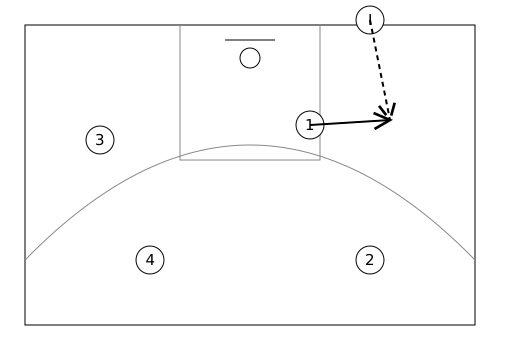
If 1 is covered, 2 moves to an outside angle. I checks that the pass is open before using it. Player 1 clears rather than stand in the same window. The inbounder enters the court only when permitted and then becomes another receiving option. Walk the fallback before adding a defender.
A sideline inbound example
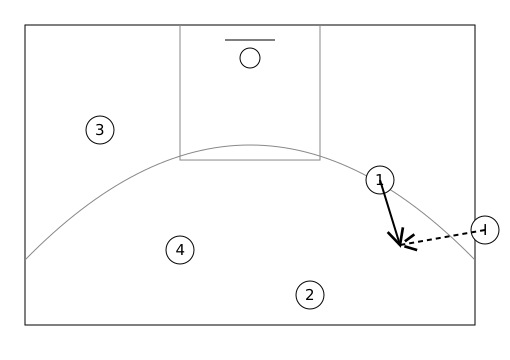
Player 1 checks toward open space rather than directly at I's feet. If the defender closes that line, 2 is the second option. Don't put both receivers in the same passing lane. After a catch, pause the first teaching version and exchange positions.
Fallback outlets and pressure
Add a passive defender to close only the first window. The inbounder should recognize the outlet without being rushed. Later add the adopted time rule. A timeout or another legal response depends on the actual code; don't invent an escape rule when the pass is unavailable.
Walk-through and coaching mistakes
Place the waiting players outside both passing lanes during the rehearsal. Ask the inbounder to name the first receiver and then point to the outlet. Change which route is open while keeping the restart spot fixed. A correct choice can be the short pass or the outlet; it need not match the first arrow on the diagram.
Rehearse the chosen restart from both sides with all players taking the inbounding job. Keep the first movement short and the second option visible. If the thrower cannot see either target, spread the setup or reduce the defense. More cuts do not fix two covered windows.
FAQ
Must the first cutter receive the pass?
No. The first cut offers a window, and the defense can close it. Keep an outlet in a different lane and let the inbounder choose. A covered first target is a reason to use the fallback, not to reward a dangerous forced throw. Walk both decisions before adding speed.
Can the thrower move along the baseline on every restart?
No. The permission depends on the restart and the adopted code. Ask the organizer and follow the official's designated spot in a game. Walk a spot throw-in and an after-score example separately if both are used. A diagram cannot grant movement that the rules for that situation do not allow.
Choose the next coaching task
Youth Basketball Tips · https://youth-basketball-tips.com/youth-basketball-inbound-plays/