
Rules, signals and court dimensions
Half court basketball dimensions: layouts and space limits
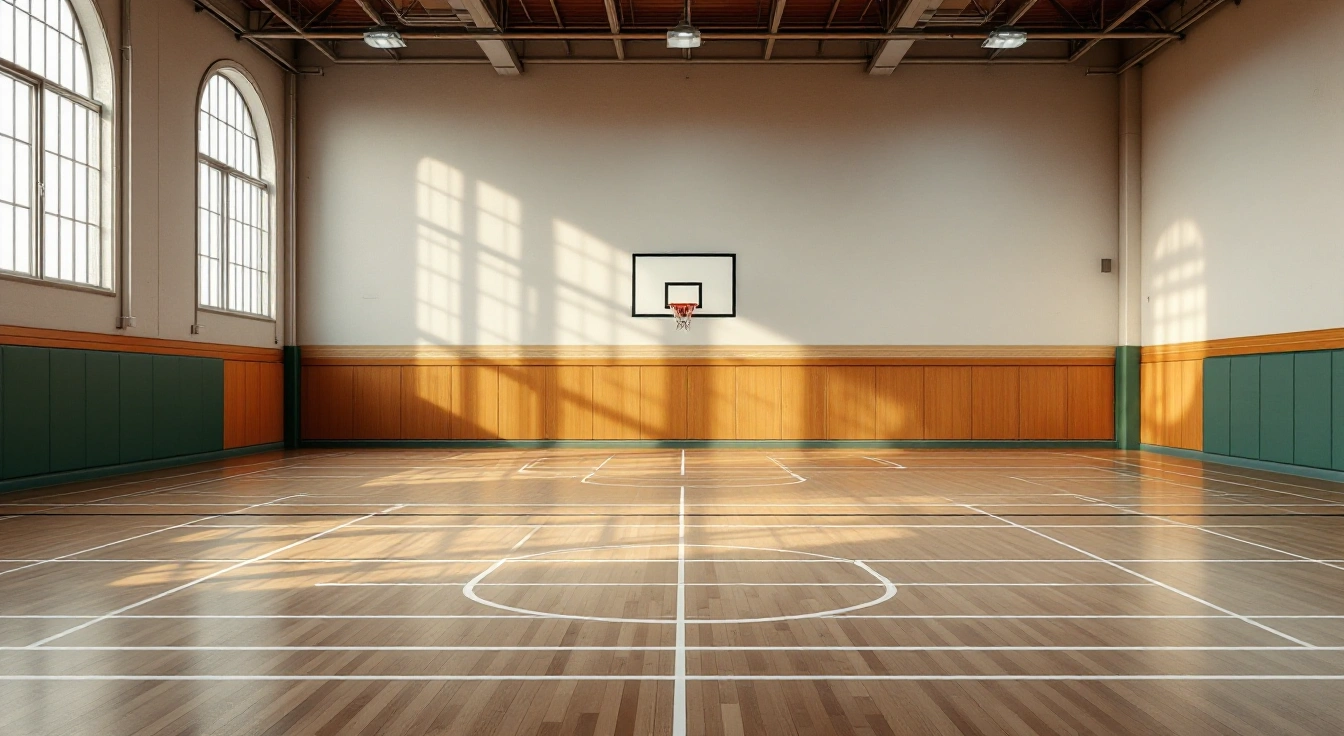
Half court basketball dimensions are usually half the playing length of a named full court, with its full width retained. That arithmetic describes a boundary. It does not tell you how much land or runoff, plus equipment clearance a home installation needs.
Half of the NFHS diagram's 84-by-50-foot optimum boundary is 42 by 50 feet. Half of a 94-by-50-foot court is 47 by 50 feet. These are derived rectangles, not a universal backyard size. A custom practice area can be smaller, but its lines and limitations should be labeled rather than called a regulation half court.
Halving the 84-foot optimum school length in the NFHS court diagram gives 42 feet. That calculation describes a half rectangle; it does not establish runoff or a construction footprint.
On this page
Regulation half court or custom home area?
First decide which task you need to fit. A school half-court practice uses one end of its existing court. A driveway shooting area may have only a basket and a short approach. A three-on-three competition may use its own official markings. These spaces should not be compared by the word “half” alone.
Ask which full-court source supplies the length and width. Halve the length only; halving both dimensions gives a quarter of the full area. If a supplier describes a “half court package,” check whether its figure includes border tiles or a hoop mounting space.
Ruleset dimensions and units
| Named basis | Derived half length | Retained width | Interpretation |
|---|---|---|---|
| NFHS optimum 84 by 50 ft | 42 ft | 50 ft | Half of the published boundary |
| Youth ages 9-11: 74 by 50 ft | 37 ft | 50 ft | Arithmetic half, not a new guideline |
| Youth ages 12-14: 94 by 50 ft option | 47 ft | 50 ft | Arithmetic half of that option |
| Custom driveway | Measure it | Measure it | No regulation claim |
| Unspecified league | UNKNOWN | UNKNOWN | Get its standard first |
Scroll for more →
The school half boundary converts to 12.8016 by 15.24 meters using 0.3048 meters per foot. Rounded to two decimal places, that is 12.80 by 15.24 meters. The figures are derived from feet. They are not FIBA's native metric specification.
For a FIBA five-on-five court, halving the native 28-meter length gives a 14-by-15-meter rectangle. This is arithmetic, not the official FIBA 3x3 court. The 2026 FIBA rules give the full-court basis.
Half-court marking diagrams
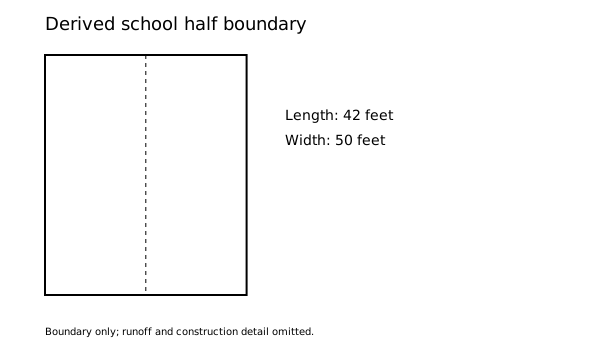
Read the 42-foot direction from the endline toward midcourt. The 50-foot direction runs between the sidelines. A basket's support may sit beyond the endline while the ring extends into play; that installation geometry is separate from the boundary rectangle.
Use the official full-court diagram for the selected end's lane and arc. Don't shrink the arc to fit a smaller rectangle and still label it the official arc. If an area ends inside the normal line, state that the line is omitted or that the activity uses a custom distance.
Playing area versus clearance
The area outside a line matters to a player slowing down or chasing a ball. A fence or wall, or a portable base can reduce usable space even when the painted rectangle fits. This guide gives no universal runoff allowance or installation certification. The venue rules and exact system manual determine what must stay clear.
For a coaching station, walk the collection and exit paths before starting. Keep another group's passing route away from the basket's rebound path. If the only open area forces players toward an obstacle, use a no-hoop skill instead. A smaller group does not remove an obstacle.
Questions to check before installation
Check the site dimensions at the surface that will actually be used, including any slope or edge. Confirm the hoop's installation manual, anchoring and overhang for the exact model. A boundary sketch is not a foundation drawing. Don't infer an in-ground system's needs from a portable model's footprint.
Ask what “width” includes in a quotation. Does the seller mean playing lines, tile coverage or the whole prepared base? Make the same distinction for length. Keep these figures separate on your planning sheet so a border or equipment position is not counted twice.
Measure the usable space
The rectangles and conversions here are original calculations from the named sources. All other dimensions remain unknown until the correct rulebook or manual supplies them. For practice, a useful half court basketball dimensions record names the source and the clear usable space, rather than a size without context.
FAQ
Is a 30-foot driveway a regulation half court?
Its length alone cannot establish that. Record the usable width, the basket position and the named standard you want to compare. A shorter area may work for a particular practice task while omitting regulation lines. Describe it as a custom area and keep its limits visible to other adults using it.
Does a 42-by-50-foot boundary include the hoop base?
No. That figure is the derived playing rectangle from the school reference used here. Equipment space and the clear area beyond the line are separate. Check the exact hoop manual and the venue requirements before treating a boundary sketch as an installation plan. Do not subtract the base from an assumed spare margin.
Choose the next coaching task
Youth Basketball Tips · https://youth-basketball-tips.com/half-court-basketball-dimensions/