
Youth basketball drills
Basketball drills for beginners: build the basic skills
Basketball drills for beginners should make the first useful action clear: control a ball or stop with it. Then receive a pass or see a teammate. A beginner can be any age. Use the version that fits today’s skill and the program’s rules rather than assume one starting level for the whole group.
Start with no-ball movement and a calm ball-control task. Add receiving, a close finish and one decision game only after the first steps are understood. Keep turns brief and avoid elimination. The drills below are original examples for adult coaches; their player counts and times are editable, and no repetition count promises a particular improvement or establishes an official training dose.
The USA Basketball foundational curriculum separates ball handling, passing and shooting. Work on the first action that breaks down before combining all three in a game.
On this page
Group and equipment checks
Check the floor and gear. Check that the right adults are there before grouping players. The adult should be able to see the working route and waiting area.
A manageable ball and flat floor spots are enough for several no-hoop tasks. Use the local age rules for defense and equipment. If the group cannot stop together, rehearse that cue before a live ball or moving defender appears.
Choose the starting level
- Goal: Match the first task to a visible action.
- Readiness: Can join a supervised still or walking task.
- Players: One worker and a partner observer.
- Space: A short clear lane and outside waiting spot.
- Equipment: Optional ball and one destination marker.
- Editable example time: 3 minutes, swap after a short turn.
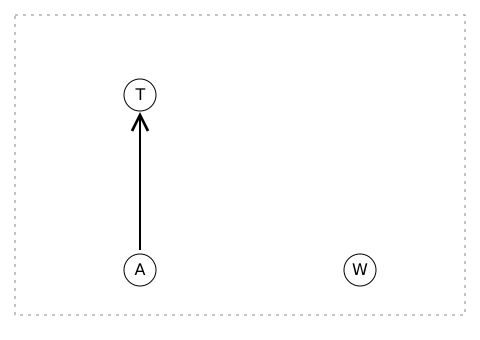
A walks to T and stops while W waits outside the lane. Run that route without a ball first, then offer a held ball or single bounce and catch. The observed stop selects the next task.
Solid arrows show player movement; dashed arrows show the ball. The dotted edge marks an illustrative work area, not regulation boundaries.
Step 1: Ask A to walk to T and stop, first without a ball. Then offer a held-ball version or one bounce and catch. The adult watches which version remains controlled rather than score the attempt against another player.
Step 2: Use that result to choose the next activity. A player who can bounce but cannot stop needs a stopping task; a player who can stop and see a receiver can move to passing. Keep a simpler version available without an ability label.
Coach cue: Find the task you can repeat calmly.
Easier version: Stand at a spot and copy the adult stop cue.
Harder version: Walk with a brief live dribble before the stop.
Observe: The adult can name the next learning task from the action shown.
Ball control and balanced stops
- Goal: End a short movement with the ball still under control.
- Readiness: Understands the stop cue and chosen ball version.
- Players: Pairs sharing a lane with one active worker.
- Space: Straight short path and separate return.
- Equipment: One ball and flat stopping spot.
- Editable example time: 4 minutes, alternate working turns.
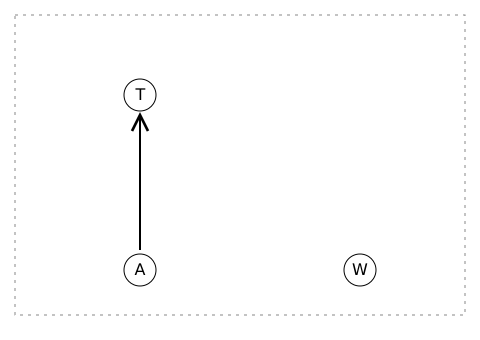
A starts with a still bounce and catch, then uses the solid route toward T if ready. Give the stop cue before the marker. W waits clear while A returns outside the active lane.
Solid arrows show player movement; dashed arrows show the ball. The dotted edge marks an illustrative work area, not regulation boundaries.
Step 1: A begins with a still bounce and deliberate catch, then walks a short live-dribble route if ready. Give the stop cue before the end marker so there is no need for a rushed turn. A looks toward the adult after stopping.
Step 2: If the ball runs away, shorten the route or allow a catch between bounces in the teaching version. Explain that each catch ends that attempt. Do not present the reset version as one continuous legal game dribble.
Coach cue: Stop the ball before choosing the next action.
Easier version: Use a held-ball walk and a still stop.
Harder version: Add a known left or right stopping spot.
Observe: The final stop leaves A balanced instead of chasing the last bounce.
Passing and receiving
- Goal: Make a gentle exchange with a ready target.
- Readiness: Can hold and receive a suitable ball.
- Players: Two per clear lane.
- Space: Close still positions away from obstacles.
- Equipment: One ball per pair.
- Editable example time: 4 minutes, pause when changing pass type.
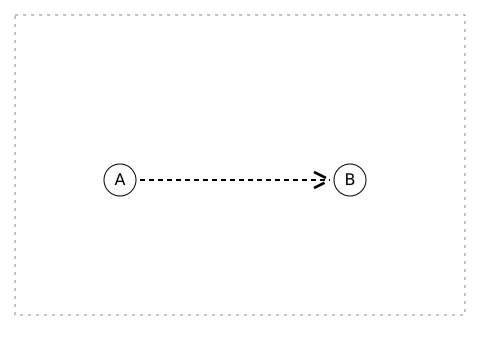
A waits for B’s eyes and hands before using the dashed passing route. B controls the catch before the return. Shorten the gap or roll the ball when a gentle catch is not yet reliable.
Solid arrows show player movement; dashed arrows show the ball. The dotted edge marks an illustrative work area, not regulation boundaries.
Step 1: A shows the ball and waits for B’s eyes and hands. Send a gentle chest pass and let B control it before returning. Choose a distance that works for a catch, not the farthest distance a player can throw.
Step 2: Try a bounce pass only if the surface gives a predictable return. Let the arriving catch guide the force and bounce point. A roll remains an acceptable simpler version of the receiving task.
Coach cue: Wait for hands you can reach.
Easier version: Roll to a still partner’s low target.
Harder version: Let B step into one nearby clear spot before the pass.
Observe: The catch stays within reach without a sudden jump or lunge.
Close-range finishing
- Goal: Reach a target with a calm release and landing.
- Readiness: Can follow one-at-a-time basket turns.
- Players: Shooter, collector and waiting player.
- Space: Close spot with separate exit and collection route.
- Equipment: One ball and suitable target or basket.
- Editable example time: 4 minutes, rotate every attempt.
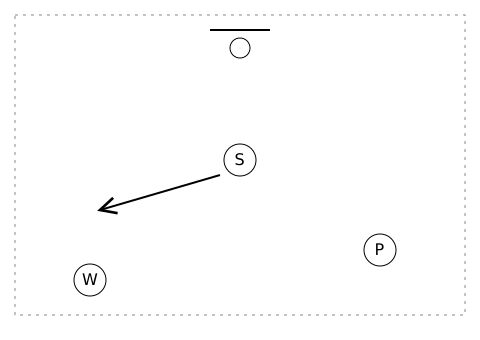
S begins with a still close shot and leaves along the solid exit. P is the collector and later feeder; W waits outside the return. The dashed feed is added only after the still attempt is settled.
Solid arrows show player movement; dashed arrows show the ball. The dotted edge marks an illustrative work area, not regulation boundaries.
Step 1: S starts close enough for a controlled still shot. The collector waits outside the landing area, and W stays outside the return route. S attempts, clears by the side and waits while the adult or collector secures the ball.
Step 2: Add a short feed from P only if the still attempt is clear. A late pass restarts rather than force a scramble. If the basket is unsuitable for the task, use a reachable target and keep the same turn-taking goal.
Coach cue: A calm attempt includes the way you leave.
Easier version: Use a floor roll to a broad target.
Harder version: Receive a gentle pass before the same close finish.
Observe: The group keeps a safe clear route, including after a miss.
A first decision game
- Goal: Choose an open pass rather than follow a fixed throw.
- Readiness: Can see and reach two close receiving spots.
- Players: Ball handler, two receivers and a passive adult.
- Space: Wide triangle with no active shot traffic.
- Equipment: One ball.
- Editable example time: 5 minutes, short decisions then rotate.
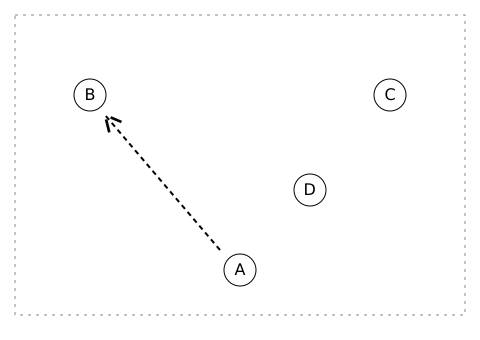
A sees B and C at separate targets while adult D closes one line. The dashed pass is one available example. A waits for ready hands or holds if neither line is open.
Solid arrows show player movement; dashed arrows show the ball. The dotted edge marks an illustrative work area, not regulation boundaries.
Step 1: A has B and C at separate visible targets. The adult blocks one line without touching the ball handler or receivers. A looks for the open target, waits for hands and sends the catchable pass.
Step 2: Change the blocked line before the next start. Later let the adult choose slowly after A receives. If neither target is open, a controlled hold ends the turn and the group discusses how a receiver could move into view.
Coach cue: See a free teammate before the pass.
Easier version: Name the open receiver before A looks up.
Harder version: Let one receiver move to a nearby empty angle.
Observe: A’s choice follows the open window instead of a memorized side.
Progress without long queues
- Goal: Use a fixed short rotation with a useful waiting job.
- Readiness: Group understands the chosen simple passing task.
- Players: Three or four with one working ball.
- Space: One passing lane and a clear outside waiting spot.
- Equipment: One ball and optional turn-order markers.
- Editable example time: 4 minutes, pause to reset the order.
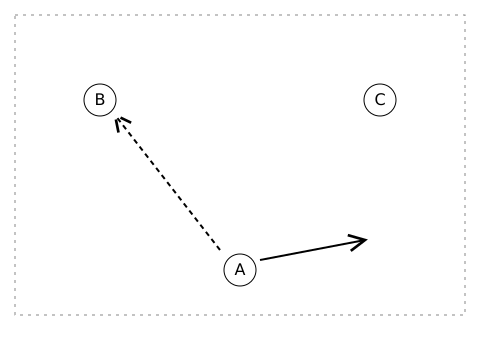
A sends to B, then moves by the solid route to the outside waiting space. C is the next receiver and enters only once the lane clears. Rotate on the catch, not on a made shot.
Solid arrows show player movement; dashed arrows show the ball. The dotted edge marks an illustrative work area, not regulation boundaries.
Step 1: Use a sender, receiver and next receiver. When the catch is controlled, the old sender exits the lane and the next worker enters. A waiting player can watch whether hands were ready, then join at the next short turn.
Step 2: Keep the order independent of made shots or dropped passes. If the wait grows long, make another supervised pair in a separate clear area or shorten the task. Do not add crossing balls to keep everyone moving in too little space.
Coach cue: Know the next turn before the ball starts.
Easier version: Use one pair while an adult explains the order.
Harder version: Add the known moving receiver after the rotation is calm.
Observe: Everyone enters a clear route and has a chance to practice the chosen action.
Put these activities into a practice
In an authored 22-minute beginner block, use 3 minutes to choose the starting version, 4 of ball control, 4 of passing, 2 for water and reset, 4 of close target work and 5 of the simple decision game. Remove or shorten any block that does not fit the group. A player can repeat the still version while another adds a slow move, provided both use the same clear cue.
Keep praise and correction tied to an action the adult observed. A dropped ball is not a reason to remove a beginner from the next turn or claim that more difficult equipment will solve the task.
FAQ
Does beginner always mean young?
No. It describes the task experience, not an age. An older first-time player may need a still catch while a younger experienced player can read a moving target. Keep the program’s equipment and defensive rules separate from that skill choice. Choose the version from an observed controlled action.
Should the first game use all ten players?
Not necessarily. A smaller task can show a pass decision with fewer moving parts. Label the teaching game’s own constraints and use the local rules where applicable. A full game is useful when the group can see its choices, but it should not be the only way a beginner gets a turn.
How can one ball serve several beginners?
Use a short fixed rotation and a clear job for the waiting partner, such as watching whether the receiver was ready. Swap often and keep the waiting position outside the route. If the adult cannot maintain useful turns, simplify or split the supervised activity rather than add unsafe crossing passes.
What is the next step after a calm attempt?
Add one demand with a reason, such as a moving receiver or a visible blocked lane. Leave the other conditions familiar so the adult can observe what changed. A single made shot is not proof that a much harder task is needed. Keep the simpler version available when control disappears.
Choose the next coaching task
Youth Basketball Tips · https://youth-basketball-tips.com/youth-basketball-drills/basketball-drills-for-beginners/