
Basketball skills
How to improve dribbling in basketball: control and decisions
How to improve dribbling in basketball depends on the control problem you can see. A player who loses the ball when looking up needs a different task from one who cannot stop. Start by watching a short attempt, then choose one part to practice rather than prescribe the same fast cone course to everyone.
Begin with a comfortable stance and a controlled bounce in clear space. Check whether the player can keep the ball near the body, look briefly toward a target and stop on cue. Add walking, a hand switch or a passive defender one at a time. The examples are editable teaching tasks, not a claim that a set number of repetitions guarantees progress.
NBA Rule 4 defines the dribble and Rule 10 governs its violations. A catch-and-reset teaching turn ends one attempt; it is not a continuous game dribble.
On this page
Observe the control problem
Give the player a short clear lane and ask for a slow trip out and back. Watch without adding a defender. Watch whether the ball gets too far ahead or crosses a lane. Check whether it stops under the hand, and whether the player can look toward the adult.
Use that observation to choose the first task. A ball that runs away can call for still control before travel. A player who can walk with the ball but never look away from it can try a visible target cue. A player who cannot stop needs a stop task before a speed task.
Don't confuse an unfamiliar drill with a lack of effort. Show the route once and give the player a turn to learn it. If the route has several turns, remove some. The coach should be able to say what the task is testing in plain language.
Keep only anonymous group observations on any public worksheet. This site has no place to submit player names or individual scores. A note that “the group could stop without chasing balls” can guide the next practice without a profile for each child.
Body position and ball contact
Ask for a comfortable stance that leaves the player able to move. The ball should remain close enough to control without leaning after every bounce. Don't force the same exact bounce height on every player or treat a fixed angle as a universal rule.
The hand directs the ball downward, then receives its return. A beginner may need to slow the bounce to feel that exchange. A coach can watch whether the hand slips underneath and the ball comes to rest. The adopted rulebook defines an illegal dribble; a teaching cue should not replace that rule.
Try an original still-control task at separate floor spots. Give each player room to miss a bounce without colliding with another. Ask for a few calm bounces with one hand, a deliberate catch and a reset. Then try the other hand from the same spot.
The catch between turns is intentional in this learning version. It ends that attempt. Do not present repeated catches and restarts as one continuous legal game dribble. Explain that the exercise isolates control; the live version later keeps the dribble going until a legal stop.
If the ball is difficult to hold or behaves erratically, check the equipment and surface. Use the program's size and inflation guidance. A coach should not assume that more force or a heavier ball fixes every problem. A smaller task can reveal whether the issue is the hand action or the setup.
Eyes-up awareness
“Keep your head up” can be too broad. Give the player something specific to see, such as an adult pointing to a left or right floor spot. The player calls the direction while keeping a calm bounce. Start still, with no moving people in the work area.
Allow a brief look down when needed rather than hide the ball from view. This guide does not use blindfolded walking or closed-eye dribbling. The player needs to see the floor and other people. A useful awareness task asks them to notice another cue while staying oriented.
When the still version works, let the player walk down a clear lane toward the adult. The adult gives the cue early enough for a calm response. If the player loses the ball each time, shorten the travel or return to the still version. Don't add a sprint as a correction for missing the cue.
Change which visible information matters only after the first cue is familiar. A direction choice and an open-receiver choice are different tasks. Tell the player which one they are reading. A coach can then observe a decision rather than whether the player happened to guess correctly.
Change hands and direction
A hand switch should leave the ball in a place the other hand can control. Start in a still stance with enough clear floor in front. Move the bounce across the body at a calm pace, then catch after the switch in the learning version. Compare where the ball lands, not how fast it travels.
Next keep the ball live through the switch. Let the player try a short exchange and stop deliberately. A bounce that goes far away is a reason to reduce the sweep or pace. Don't ask for between-the-legs or behind-the-back moves before the simple transfer is understood.
Direction adds another part. Mark a broad turn rather than a sharp obstacle course. Walk toward it, switch or keep the hand as the task requires, and leave through a clear return lane. Put the next player's waiting position outside that path.
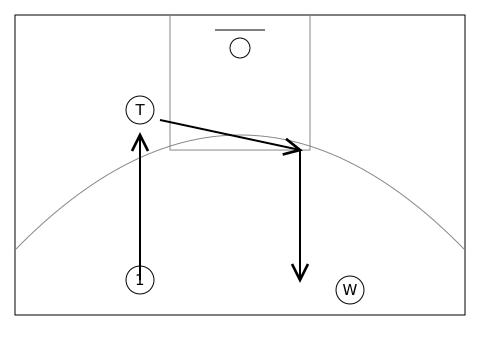
For a reactive version, the adult points toward one of two clear exits before the turn. The player chooses the open direction without racing. Keep the signal visible and the exits far enough apart to be distinct. An ambiguous cue is an adult setup problem, not evidence of poor player attention.
Protect the ball legally
Ball protection begins with position and awareness. The player can keep the body between the ball and a controlled defender while staying within the adopted contact rules. The free arm is not permission to shove, hook or hold another person.
Use a shadow defender first. That defender follows at walking pace with hands back and no attempt to steal. The dribbler travels through a wide lane, turns toward an open exit and ends with a controlled stop. Exchange jobs before adding a live reaching task.
If the player turns their back and loses sight of every outlet, add a nearby stationary receiver outside the lane. The dribbler looks for that person and passes when the route is open. Protection should keep a useful next action, not simply hide the ball until the task ends.
Check the program's rules on stealing and crowding for younger age groups. A drill can be too much pressure even if an older game allows it. Do not add two defenders just because the player survived one rushed turn. Readiness is shown by control and decisions in the present task.
Choose a suitable next drill
| Observed need | Starting task | Ready to add |
|---|---|---|
| Ball runs away while still | Calm bounce and deliberate catch | A short continuous turn |
| Eyes stay fixed downward | Still bounce with one visible cue | Walking toward the cue |
| Hand switch loses control | Still transfer with a reset | A live transfer |
| Turns enter another lane | Broad marked one-way turn | A direction choice |
| Pressure removes all options | Shadow defender and one outlet | A slow active defender |
Scroll for more →
Keep the next attempt close to the successful one. If you add movement, leave the hand task the same. If you add a defender, leave the route familiar. A player should know what part has changed and what they are trying to observe.
Stop a turn when a loose ball enters another group's area. Teach the player to look before collecting it. Repeated chases mean the task or space needs adjustment. Finishing the assigned time is less useful than restoring a clear route.
A short feedback sequence for an adult coach
Use a floor line as a simple observation point. Ask the player to travel beside it with room to stop. Watch whether the ball stays within reach as the player changes pace. If it runs ahead, shorten the route and slow the task. Keep the same ball and hand while checking that change, so the feedback concerns one clear action.
This original six-minute example separates observation from correction. Use the first minute to show a broad out-and-back route without a ball. In the next minute, let players try a slow live dribble with no cue. Watch where control breaks down before deciding what to say.
Use the third minute for one teaching choice. If the ball runs ahead, shorten the travel and show a close bounce. If the eyes stay down, point toward a large visible target. Do not add both changes at once. The player needs to know which part they are trying to repeat.
In the fourth minute, repeat the same route with that cue. The adult stays in the same viewing position. Compare the action under the same conditions instead of adding more speed because one attempt worked. A calm repeat is enough evidence to choose the next task; it is not a measured long-term improvement.
Use the fifth minute for a brief pause and a player explanation. Ask what helped keep the ball in the lane, then accept a short answer. A player can point to the bounce spot rather than give a speech. The adult can restate the cue in the player's words if it remains accurate.
Finish with one minute of a familiar task that the group can manage. Keep the stop cue and collection route the same. If the last attempt is rushed, return to a still bounce before ending. The session should not become a race to finish on a made-up score.
The six minutes are a scheduling example, not a required daily dose. Shorten any part when the group needs a pause. An assisting adult can watch the return lane while the teaching adult observes the bounce. If you cannot see both the active player and the collection area, simplify the route or reduce the group size.
FAQ
How long should a beginner dribble each day?
This page gives no daily workload prescription. Use the program's age and participation guidance, account for other activity and keep the task short enough for controlled attempts. The coach can shorten a block when the ball or attention repeatedly gets away. More repetitions alone do not establish a better task.
Does the weaker hand need a harder ball?
No such requirement follows from this guide. Use suitable program-approved equipment and a simpler distance or pace for the less familiar hand. Compare control under the same task before adding difficulty. A heavier ball is not a substitute for a clear cue, a usable surface and time to learn the movement.
Choose the next coaching task
Youth Basketball Tips · https://youth-basketball-tips.com/how-to-dribble-a-basketball.html